Tuesday, December 19, 2006


Tuesday, December 20, 2005
 Croatian Chronicles:
Discovering My Roots
Flight to
I now have a reason to become wealthy -- 1st Class Travel!
There I am in the SF airport by the United departure gate waiting for the boarding line to ease up a bit. Suddenly, and unexpectedly, I hear my name called. Since I had my boarding pass, this surprised me, but I dutifully followed the voice to its owner. "Ahh, Mr. Garma, follow me". And I did, down a private walkway into the First Class entrance to the plane. "Have a nice flight", she said smilingly.
I'm near a window, sitting in a multi-position-enabled lounge chair that's set at a 30 degree angle to the windows, so that you can see through 5 of them. The lumbar roller is rolling out my stress spots. My carnivorous friends take note -- I'll be ordering the Tilapic fillet with cornbread and pomodoro sauce. I know this is an unusual selection for me, but I'll need something heavy to absorb the Vincent Giradin Santeny Cru La Maladiere 2001
Somewhere behind me, far far away and hidden, are the regular people. Since this is a full flight, I can imagine how they're all stuck together, since I used to be a regular person myself.
Life does have its ups and downs and my moment of Aristocratic splendor ended abruptly in
 The Bus to
 Like everything in this country, it's accumulated quite a story over the centuries, the most recent weighty chapter being the war with
After picking up my bag from baggage claim, I stand outside to await my bus to the city. A slight figured man appears before me and starts speaking Croatian. He quickly perceives my befuddlement and begins speaking English, which is unexpected, as rather than being young and hip (two characteristics of English-speaking Croats) his faced is deeply creased from hard living and cigarettes (which he rolls like joints). He wears an old suit. We board the bus and he sits next to me.
We share our stories. He lives in nearby
About half an hour later, we arrive in
After checking in, I begin my walkabout. The main city centers are within walking distance. Night falls, and I keep walking. Soon, walking turns to limping, as my Achilles tendon persists in giving me the middle finger. My hip – the one injured by a bicycle injury two years ago, joins the tendon’s protest. If anyone spotted me in the shadows, they thought, "I hope that poor old man makes it home before he collapses".
After 36 hours of wakefulness, I thought I'd fall asleep quickly once my head hit the pillow, but I soon learned that
 Hello Boris (10/2/05)
Although I didn't consult my watch, it felt like I awoke every hour from 3:00 AM to 7:00 AM, at which time I threw in the towel and got up. I didn't have to stumble far to the bathroom. A single room at hotel Slisko has its bed one stride from the bathroom. As soon as I had the thought, I was beside the pot.
Though groggy and jet lagged, I am determined to end the old man hobble, so I rearranged the room some and "did" some yoga. By 9:00 AM, I’m downstairs flipping through magazines and waiting for Boris. A car drives up at 9:15, and out pops my cousin.
Basically strangers, we’re unsure how to great each other. After an awkward beat or two, we shake hands, both grinning. I expect only to share a cup of java and some stories, but he has other intentions. We spend the day together.
What a difference to have a local person as your guide, especially one so educated and thoughtful. Though Boris is a professor of mathematics, he studied other disciplines. As he shows me the sights -- old churches, museums, town squares, et al -- we delve into economics, political philosophy, Croatian and family history.
"I do not like religion", he says emphatically. "How can people not understand the manipulation?"
This was said after we observed what must be
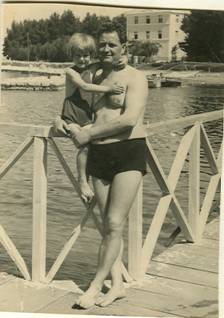
"My Grandfather, your Grandfather's brother, was very influential to me. I loved him and listened to him. He told me two things over and over again. One was that the church is about control. It demanded money from his parents who were so poor that they sometimes had to do without food. Your Grandfather also hated the church. The other thing my Grandfather told me was never to gamble. Your Grandfather was a gambler and although he helped his brother – my Grandfather -- during and after WWII, my Grandfather knew that gambling hurt him”. He went on with a disgusted tone: "During the Homeland War (
Photo of Ante Sharac holding Vanja, circa 1948.
 Boris's grandfather was named Ante Sharac. My mother's father, Ante's brother was named Jack (Ivan) and a third brother was named Josef. Josef was brilliant and sent to
 Ante's brother, Jack, my Grandfather, produced Doris, my Mother. The chemist, Josef, produced Ruza, also a PhD Chemist, who I later will meet. These three brothers owned a house in Sibenik, and it was the recent selling of this property that brought a cast of characters together after nearly 50 years, as the inheritors -- children of Ante, Jack and Josef – deal with the paperwork and funds from the sale.
Photo of Josef Sharac, circa 1930.
Boris takes me to a lake where the citizen's of
I didn't want to say goodbye to my cousin. But what else could we do. Tomorrow, I'm off to Zadar.
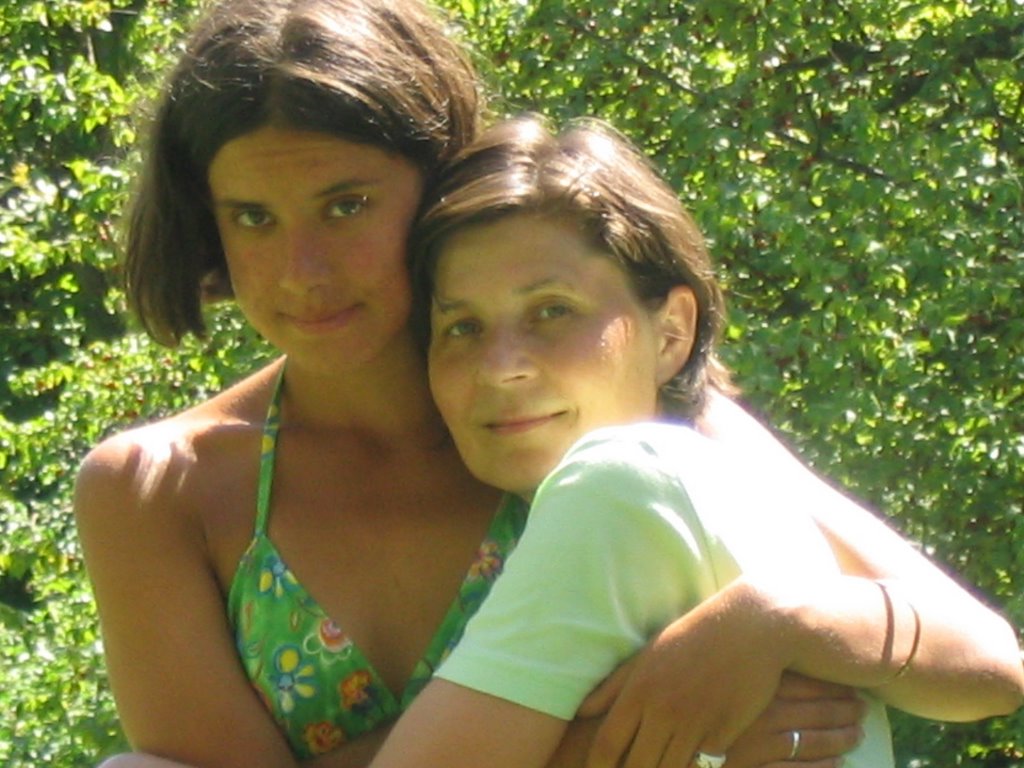
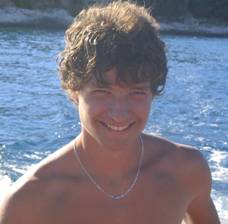
Pictures above are of Boris's son Ivica Culina, daughter Antica and wife Dragana.
 To Zadar (10/3)
Humper
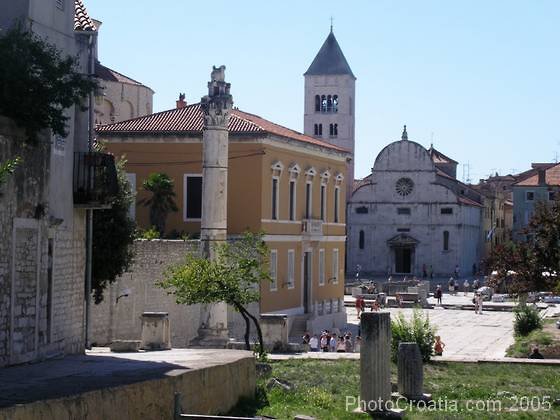 Accommodating Zadar
Traveling like I do is work, perhaps the most I’ve had of late. You gotta figure out how to get from A to B, get the ticket, find the bus, deflect scowls, know when to get off the bus, find the luggage storage so you can be less encumbered as you trot around looking for accommodations that you can afford, arrange for the place and price, find the place, and pass out for an hour before exploring B.
 Rummaging around Zadar
I’m hungry. Besides the meal at my cousins in
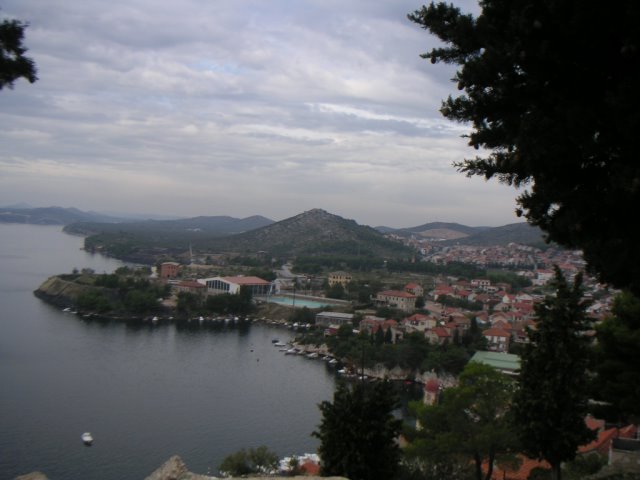 Sibenik (10/4-6)
My trusty guidebook said that “Nik Travel” in Sibenik could book me a private accommodation and they did. After disembarking from the bus after an hour and a half ride south along the coast from Zadar, I go to the Information Booth and without hesitation, after some garbled attempt at “Good Day”, went straight into English and inquired the whereabouts of Nik. As providence would have it, I find it, almost straightaway, about one km away.
http://www.photocroatia.com/GALLERY/photo.php?photo=8949&u=1904|37
Again, rather than ask in Croatian if the Nik gal understood English which usually results in a confused look framed by knitted eyebrows, I ask the question in English. “Yes, yes”, was my answer. Sigh. In 20 minutes, the dapper owner of an apartment appeared in the office and drives me to my very own apartment for the next two days. I scored on this one -- two bedrooms, three beds, bathroom, kitchen and balcony just for moi (err, “te” in Croatian) for about $35/night. Helps to be here off-season, but for the rain.
Well, I have another day and a half to find it, I reason, so let it go. Before going through the gate in a tight alley that leads up one story to my apartment, I enter a modest size grocer to buy some grub to cook; I have a kitchen after all. Everyone parks their umbrellas by the door, but I don’t have an umbrella because I’m real decked out in a super tech jacket that does it all: anti-wind/wet/cold and some style to boot. I wander around, and bring my catch to the cashier. She looks at me with some tired took, sighs, takes my apple somewhere to be weighed, brings it back in its own brown bag and tells me what I owe in English. She definitely didn’t take me for Igor.
 Serendipity in Kraponj
October 5th is my second day in Sibenik. I head off to find Kraponj, the small island that once long ago produced my paternal Grandfather, Anton Garma. The lady at the bus depot's
I enter a cafe up the hill and was summarily dismissed by an irritated man saying "Arrete, Arrete." So I entered another cafe across the street and approached a woman behind a bar. Yes, she spoke English and told me when the boat would arrive, but was particularly disinterested in my expressed my familial reasons for visiting Kraponj.
But the Mike Dikta look-alike character I observed sipping his pivo (beer) at a corner table is not. "Say your Grandpa's name again", he bellowed out in a strange Croatian-Aussie accent. I told him. He waves me over. I sit down just as my kava (coffee) is served. Lovre is his name and he proceeds to tell me all about the Garma's he knows. "Come with me" he tells me, and we walk down the hill just as a small canopy covered boat arrives to putter us to Kraponj.
Along the way, Lovre introduces me to everyone in earshot, and retells my story. Some nod appreciatively; others say the Croatian equivalent of "No, don't know Anton, but what about so and so Garma"?
The boat slides into its docking station. No one asks for fare, so I follow Lovre who beelines for an elderly, hunched man. They start talking. The man looks at me. They continue talking. The man again looks at me and slowly, like a sun rise, he smiles and thrusts out his right hand to shake mine. His name is Rocco Garma, and he claims he is my father's cousin.
Lovre fades left, and Roco takes me for a walk around the island known for it's flatness, average elevation (three meters) and fame (sponges and the world record holder for underwater breath holding). The walk lasts one hour, but seems longer as I fence with his Croatian and he shakes his head disapprovingly that I don't know my mother/father tongue.
He shows me Anton's house, which is next to his own. It’s rubble. Nice looking stone though – a naturally formed heap. Roco's doesn’t look much better, so I’m shocked to find a modern looking, clean home inside the, well, visibly organized rubble that constitutes the outside of the house. Inside is a diminutive woman in traditional grab, almost Muslim like, with a scarf covering her head. His wife, he says. We shake hands. No sun rise here, just some head nodding. I decline the offer of drink and Roco and I continued our walkabout until I say goodbye at the wharf. We hesitate for a moment, we two of different generations, from such different worlds, and yet connected by blood. He sighs and turns away.
 The return trip to Sibenik is less expensive. Knowledge is a valuable thing. Armed with knowing when and where the bus would come, I used it. But not knowing what the fare was or what the fare man told me it was, I held out a hand filled with coins. He took 15 Kunas ($2.10) and gave me a receipt that I saw once seated read 6 Kunas. Well, another rip off, but I was happy that I wasn't in a taxi, particularly since a busload of teenagers just returning home from school kept me entertained all 5 clicks to Sibenik.
 Photo:http://www.photocroatia.com/GALLERY/photo.php?photo=1742&u=1904|87
Two hits in one day?
Back in Sibenik, I try again to find my mother's father's house. It starts raining hard. I persist. The rain, failing to dissuade me patiently waits for the night to join ranks and together they press me to abandon the search. Finally, I do so and begin a new search for an Internet Cafe. This proves to be almost as tough as finding Granpa Sharac’s house, but this time I prevail in finding perhaps the only such place in a town of 30,000 people, carefully tucked away upstairs in a bar which says "Bar" outside, not "Internet Cafe". I find this to be the perfect combination... beer and a computer... and I type away as an efficient bar maid climbs the curving steps to my perch and feeds me beer. She makes several such trips and I am happy.
One More Attempt
October 6 is the last day to find the house that Grandpa Jack owned with two brothers, the recent selling of which brought my far flung relatives here in Croatia in communication with us Americans once again. I only have till 10:00 AM to accomplish this deed. There are literally many twists and turns in this story, but suffice to say I found it.
I ask three people, including the Tourist Agency, where it might be, and they all squint,
I need to find "Ruze Vukum #1". With the map crumpled in my hand, I climb one of the many steep stone stairs that cling to steep hills reminiscent of
I find Ruze Vukum #1 just about 1 km from the alley where I was staying. One thing that my Grandfathers have in common is that both their houses are now basically rubble.
Satisfied with my intrepid deed, I roll down the hill to the bus stop just in time to board the bus to

To Split (10/6)
General Wesley Clark, then Supreme Commander of NATO, who bombed
Upon arriving in Split, I park my luggage in a secure zone, and went looking for Daluma Travel where I arranged a "private accommodation" in Split near the Old City which features Diocletian's Palace, one of the most intact and spectacular ancient architecture in the world.
Daluma was within one block of the bus station, and there I met my email correspond and owner of the agency, Stepjan, a white haired man with twinkling eyes and an easy smile. He told me he arranged a room within 200 meters from the hotel in the "Palace" where I would meet up with my friends later in the day.
 Hotel Peristil, Split, Croatia: www.hotelperistil.com
In the 15 minutes it took to retrieve my luggage and return to the agency, the owner of the apartment containing my room was already waiting under an umbrella to escort me. She’s in a hurry to show me the accommodations and then board a bus to get to the school where she taught literature. Our walk to the apartment is a comedic scene of me both pulling my wheeled luggage and lugging it over steep stairs, as she maintains a breathless pace.
Of course, I get lost, but after wandering for awhile, I’m back on track through the blessed instructions from a Turist Biro (one's in every town). There's a message for me from Mike at his hotel. I will join them in the hotel restaurant at 6:30 PM, which I do, and thereupon meet the my comrades: Mike, gal friend Colleen; George, wife Judy; Stan, and wife Mary.
 Krka (10/7)
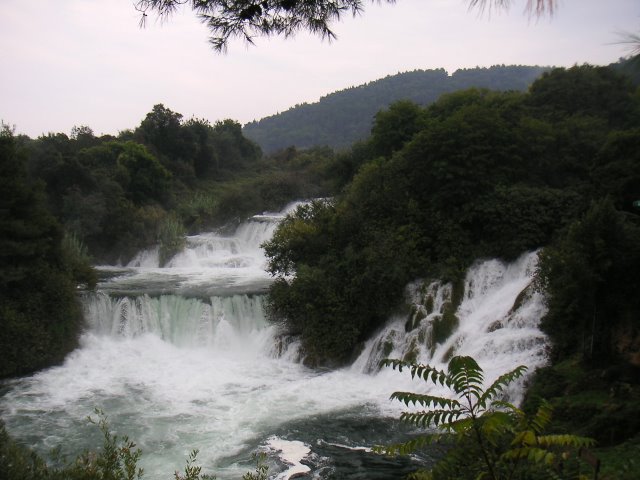
We get to Krka about a half hour before the rain. It's a natural wonder.
A boat ride takes us to a mezzanine of waterfalls and wooden paths suspended over soggy moss, rivulets and rocks. All of us are wet and totally delighted.
Tomorrow, I meet my mother's first cousin, Vanja, mother of Boris, and her husband, Mirko. Then board the gulet and sail away to our first island adventure in the rain, of course.
 A Relative Joy (10/8)
 Miscommunication and a change of plans about when to launch the sailboat, a 66 foot Turkish made "gulet" named “Hera” put some egg on my face; twice I had to call my Mother's cousin, Vanja, via an English/Croatian speaker to change plans. But finally, the date was set: today at 9:30 AM we meet at the beautiful Hotel Peristil which is not only within Diocletian’s Palace, but shares an original wall with the palace garrison wall built some 1,700 years ago.
 Diocletian was quite a character.
 This Son of Jupiter thought it politically expedient to kill Christians, but was particularly wary of his potential future. Since he knew that the Roman emperors before him commonly ended their reigns in a particularly unsettling manner -- assassination -- our guy decided that he'd rather retire, the first Roman Emperor to do so. In 295, a good ten years before retirement, he started building his retirement palace in
 Just before 9:30 AM, I stand amidst all this antiquity, in the drizzle, looking for Vanja. I saw her before she saw me, and despite her being nearly 50 years older than the picture I had of her in my pocket, her beauty was undiminished. I smiled at her and she then knew it was me. She came with a neighbor, Josef, who grew up with her son Boris; together they played soccer across the street from their home in a field that is no longer. Josef is our interpreter. Vanja speaks some English -- after all she had studied English written textbooks all through college and dental school, but since she had few opportunities to speak the language, she is unconfident and hesitant. We walk a short distance outside the palace walls, pile into Josef's black new Jeep, and drive 15 minutes to Vanja's home.
Mirko, Vanja's husband, greeted us at the door. He speaks no English, but his eyes speak his affection for this moment. He’s been ill of late and looks a bit weary and rumpled, but at the same time is delighted by our company. Ushered into the living room, a bottle of Scotch is soon produced and toasts are made. We had an hour and a half to visit, and I want to absorb every minute of it.
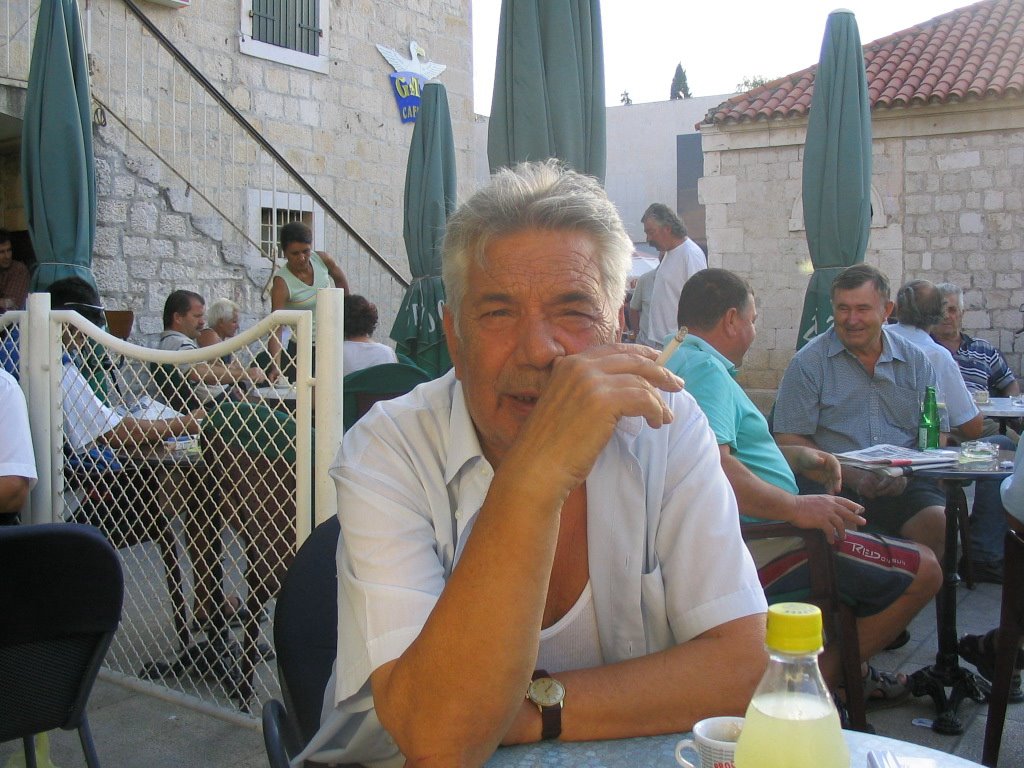 Vanja slip outside the room, silently closing the door. Josef, Mirko and I became acquainted. The stories unfold. Vanja pops in again, momentarily; Mirko smiled at her and they locked eyes for a heartbeat. When she’s gone, he looks at me and says something in Croatian. Josef smiles, turns to me and interprets: "I'm in love with my wife". Like father like son, I think, as I reflect what Boris had told me during our café in a
As the time passes, I start getting anxious. Where was Vanja, I inquire. Making lunch, I’m told. But time is running out, I stammer. She’s doing what’s traditional, I’m told. Finally, the door opens and Vanja motions us to follow her into the kitchen. On the table is a serving bowl full of freshly made soup, a platter of lamb and chicken, and bowls of beets and salad. A feast!
