Monday, June 04, 2007


March 31, 2004 -- To Guatemala for Isabella

The Marin Airporter takes us to the airport; my sister Kerrilyn is on her cell, while I try to remember that I’m going to Guatemala, as opposed to being on a commuter bus ride to the City (San Francisco).

At the airport we have extra time. Kerrilyn yearns for breakfast, so we sit at a microwave café, which produces rubbery eggs on a bagel of dubious heritage. (I was certain that its father was a nerf ball.) I stare at my cup of tea and ponder the purpose of our trip and what spawned it. The events leading up to this moment began to come into focus.

It had been such a whirlwind of activities, brief reckonings, and three-way discussions between Mom, Kerrilyn and me, mostly with just two of us present, the third being invoked by the conveyance of “he said, she said”. Where did this adoption thing come from? I hadn’t seen it percolating; suddenly, it was just here.

“How did this happen, Kerr?” I was looking at her intently. She stared at my tea.

“When I first learned that I was sick in Chile last August, I didn’t know how sick. It took awhile for the tests to be conclusive. I worried that I might have cancer. I looked at my life and thought about how I would feel if I died. I felt I hadn’t experienced what I wanted. All I did was work. I had missed some of life’s greatest moments, and its greatest gift -- motherhood. For years I had contemplated adoption and one day in Chile became resolved that I’d get better and do it. I’d become a mom.”

“How did you know it was right, that you weren’t making a mistake based on a temporal emotional yearning?” I asked her. (Yes, I do sometimes talk like that.) “You stay with it”, she replied. “I just had the knowingness that it was right for me.” “Come on Kerr, what’s this knowingness?” I asked in the frustrated tone of someone whose compass is bereft of magnetism. Ahhh, that knowing look was leveled at me: “It’s a steady feeling that’s in your mind and heart, and it brings a smile to your face.”

Kerrilyn and I are closer than most siblings I’ve observed, and yet the deeply personal process she undertook to arrive at this resolve was not and perhaps can not truly be shared in its details, yet it’s instructive by its two traits: ambition and conclusiveness. We were at the brink of a journey that will change who she would become forevermore. And, perhaps, me as well.

April 1, 2004 -- Embassy Blessings

April first is a strange day to start a new life by undertaking the greatest commitment and life-altering journey undertaken by us humans. I’m hoping motherhood, commenced on this day, will balance the serious stuff that’s to come. Today, we have a date with the U.S. embassy, for they must bless this union; under their auspices, it becomes officially real.

We arrive at the embassy by 6:45 AM. Already, the Sun is over everything and a long line of supplicants wait in a thick line. Kerrilyn and I sit anticipating the arrival of Areselli, the baby’s foster mother, who will be bearing the great gift of motherhood. Gradually, several other Gringos appear at the embassy with their Guatemalan treasures, each with a facilitator to help guide the labyrinthine adoption and embassy procedures.

Shoeshine salesmen swarm. Guatemalan men are fastidious about their footwear: it must be leather and a shoe or cowboy boot -- sneakers are for girls. One shoe shiner is particularly tenacious. He is obeisant before his prospect, jabbering away, motioning to the bench upon which he wants the man to sit. The man stares past him as if he’s not there, and yet, some imperceptible motion by the prospect invigorates the shoe shiner who gestures with greater vigor, and through the force of his intention, guides the man to the bench. Robotically, the customer sits and obediently places a boot upon the wooden, badly scuffed shoeshine block. The shoe shiner's black pocked hands swirl. His mind seems far away and disconnected from the task as deft hands massage polish into the leather and buffs a lustrous shine.

Soon, like a stout, short, earthborn stork, Aristelli appears carrying a large blanket-clad bundle. She stops before us. Kerrilyn’s face opens, her eyes glisten and she moves hesitatingly to embrace the sleeping child that in two more hours would officially be hers.

I watch the watchers who passively watch the Gringos with their Guatemalan children and wonder what they’re thinking about these privileged foreigners taking the children from their difficult country. Mostly Mayan --hardy survivors from centuries of oppression --these people have learned to roll with the punches, literally. Now becalmed (prior to 1996 only the most adventurous traveler came to this country), Guatemala had for years been embroiled in civil strife, not unlike so many Central and South American countries.

By 7:30 AM we adopters are motioned to move through the various turnstiles, and detection machines that guide us to the inner sanctum of the embassy. In line, I notice a hippie-looking American woman with a one-year old boy bundled in the traditional baby sarong slung over her hip. I watch as she moves, for it’s a study in economy. Everything is efficient. Even her Spanish is laconic; I later learn, she’s lived here four years.

We’re among the first group in the waiting room to wait our turn to meet with officials, but the room soon fills. Half of its inhabitants are Gringo Moms and Dads holding dearly to the children whose lives they’re about to join. The other half are locals seeking immigration status; they wear their finest clothes and most cherished hopes. Many of the parents-to-be are much older than new parents typically are, perhaps even by Marin County (California) standards!

What travails they underwent to get to this point, I can only guess. What fears were wrestled about starting this journey so late, I can only guess. Perhaps, like Kerrilyn, there’s no fear in sight of conviction.

I never speak to the hippie gal, but I learn much about her, the advantage of a long ear. She lives in a Pueblo community in a house bought two years ago on an island three hours from here. She and a friend started a non-profit to teach the traditional women to form weaving cooperatives, to teach about sustainable forestry, and anything else that can help them. She used to live at a Buddhist Zen center, Spirit Rock, which sits on a knoll just 30 miles from my home. Small world. Large person.

I study Kerrilyn as we wait. As is her way, the surface is calm, betrayed only by an occasional glance at me attended by a nervous smile. Though only four months have transpired since Kerrilyn first met and fell in love with an 18-day old baby girl, the time was tense, frantic and emotional. Including this trip, five times Kerrilyn journeyed here to first meet and then ensure that Isabella would be hers. Along the way, she greased every avenue potentially leading to her prize, filled-out and had notarized dozens of documents, managed the foster family, lawyers, agencies and the state department. She also witnesses a shooting.

On her second visit, Kerr was in a taxi cab looking for Ariselli’s home, which is in a run-down neighborhood in Guatemala City. The taxi pulled over so that addresses could be read. Suddenly, a man sprinted by followed by another who stopped abruptly in front of the cab, pulled a pistol from his belt, and fired eight shots. They all missed. The shooter calmly put the gun away and faded into an unfazed crowd. A week later, he tried again, and it was reported, he didn’t miss.

Within two hours, we were done for the morning embassy session, and were told to return by 3:30 PM to retrieve the visa and passport, which, after I had a long and cathartic workout at the Marriott, we did.

Alas, and at long last, Isabella, you have a mom.

April 2, 2004 ­ Hello Antigua

I didn’t really wake up this morning as surface from a shallow nap. Two cabs brought us the 45-minute tortured ride from Guatemala City to Antigua. Rock stars travel with groupies, and Kerr has her daughter, her daughter’s former foster mother, Ariellie, this woman’s shy granddaughter, Carolina, me, and trunks of baby-stuff.

The drive stunk… literally! Never having had the pleasant experience of Mexico City, my lungs were unprepared for the onslaught of smog and other black airborne beasts expectorated from every exhaust pipe that jostled with us along the road to Antigua. I was miserable and became very philosophical with the recognition that this is how most of humanity is living. I blessed our environmentalists, our Clean Air Act, and wished that every American who thinks that kooks populate the Sierra Club had a chance to sit with me in a cab from Guatemala City to Antigua.

I knew we had arrived in Antigua because the paved road turned into cobblestones and my teeth started rattling. Besides the cobblestones, Antigua is characterized by its layout. Picture a checkerboard: ­the streets are pretty much perpendicular to one another. Along them, there are either walls hiding courtyards or storefronts. The colors of walls and buildings, few more than one story high, alternate from yellow, beige, salmon, green, brown and the like. It’s sometimes hard to tell the quality of neighborhood, unless you happen to look into a courtyard; some are true oasis of manicured luxury; others are derelict. As I peer into a few, I’m reminded of Alice’s Looking Glass, for what I see is an altered reality. If you were only to crisscross this city along the streets, you wouldn’t truly see Antigua.

Upon this I mused as I stirred in preparation to get up and greet the day. The baby was crying upstairs in Kerrilyn’s room, a familiar sound as this pitch, along with an overactive refrigerator and noisy neighbors, kept me from the deep end of sleep the whole night through. Not to mention the couch I was sleeping on is 18” wide. I'm not.

Ariselli and Caroline start clanging in the kitchen. I abandon my stingy perch and go upstairs to see how Isabella is doing. She’s been sick, and as we later learn from the pediatrician ($9 office visit), suffers from some virus and a swollen throat; hence the crying. I find Kerr hovering over her. Both mother and daughter are bleary-eyed.

I shower, make breakfast for everyone, and, after a navigational briefing from Kerr, go off to explore Antigua.

I meander. The narrow bumpy streets are choked with traffic. I’m still weary of dirty air from yesterday’s pilgrimage from Guatemala City to Antigua, so my mood is fouler than the air. I constantly bring a bright red handkerchief to my nose and mouth, particularly when buses rumble by, and I make an exaggerated point of letting the locals see my indignant and impossible fight, as if this will stir them to think, "Oh, our visitor Joe is finding our air quality subpar... let's clean it up him!"

Soon, I’m on the outskirts of the core few central blocks of town. There are fewer Gringos here and I stick out. Everyone is five foot something. At 6' 4" I feel like Gulliver and anxiously scan for little people scurrying around with ropes and little tie-down stakes.

The Mercado presents every type of fruit and vegetable. This whole country lies in the tropics -- the humidity and temperature vary little, and in combination with the volcanic soil, things grow abundantly.

I make my way to a large yellow church in a miniature version of the main downtown central square. There’s a bustle of activity around the church as people prepare for Palm Sunday this Sunday. Food vendors and a plethora of trinket hawkers line the square. I sit on the obligatory fountain, one of the few without a mermaid-inspired figure with water gushing from her nipples into the pool. After three hours of walking, I’m quite prepared to sit and let the sights come to me. And they do!

There's some Gringos frolicking about. I see one Caucasian man with a yellow polo shirt barely concealing his bulging stomach, and although his belly is not particularly noteworthy, the ornate scabbard sword dangling form his belt buckle holds my attention. I later see them sold in several places, but at the time I just thought he was a lone nut.

Two women, who look like twins, bedecked in the same colorfully traditional clothes, and hair braids, stand behind a fruit stand and expertly cut tropical fruit with a small machete, and then place it in a plastic bag that is hung on a hook in front of the stand. They both sip Coca Cola from a straw; the irony is not lost on me.

As ever, wherever you go in the world, Germans stroll by.

I go into the church and sit in a pew. All along one side are several wooden statues depicting various scenes of the Crucifixion. The carvings are intricate and real looking. Christ is short and brown, but his facial features are European. I’m thinking that the chief artist was Spanish. Funny, Christ always looks European. Even in Gibson’s The Passion of Christ -- a movie that so grasps for realism that the actors speak Amaric and Latin – Christ, unrealistically, maintains his European look. I wonder what the Buddha would look like if his religion was kick-started in Rome.

Dinner is with the gals at “home”, but tiring of all the cooing, and figuring that I’m not gonna get any attention with Isabella around, I head out for the evening. Without planning it, I find myself at the yellow church. I see a comely young blond woman speaking animatedly to two Guatemalans. She turns to me and asks if I’m waiting for someone. I’m glad she decided to switch to English so I could answer her: “No”, I said, “Just taking in the sights”. I learn that she’s from Santa Barbara, attended my alma mater, UCSB (small world again), quit her corporate job (what, like after only three years of work!), and came here to study Spanish.

New Friends

Two industries keep Antigua going: tourism and language schools. There are over 1,500 people in prime time living here to study Spanish, each, mostly, one-on-one with a teacher.

“How do you like Antigua so far”, the Santa Barbarian asks me. “It reminds me of a few towns I’ve visited before in Chile and Mexico,” I reply, “but the air and traffic is getting to me.” “Oh,” she says as she puts out her cigarette, her gaze already elsewhere, “have a nice night.”

I cross the street, I begin plodding down it when I hear music that I like. Pausing at the open window, I peer in and see an intimate setting with a few tables hovering around a curved bar at which sit six women sit giggling. Hmmm. I go in and sit at the last remaining stool. “Cervasa por favor”, I call out. A decidedly non-Guatemalan serves me the local brew. She’s quite chatty. From Holland I learn. Soon, without ever paying me so much as a glance, half the gals disappear. A pleasant looking chap sits down near me. Turns out his name is Ole, a Norwegian, has been coming to Antigua since 1990, married a local, now divorced, but she’s living in Norway with a child, not his but the Iranian’s whose ex-wife was with Ole, but no longer. He sends them all money from time to time, and makes it doing odd software development for local businesses. He seems very bright, and has language skills that are envious.

The bar gal is back with another beer, named “Gallo” (pronounced “Gaeyo”) which means "cock", and is aptly represented by the big rooster on the label. She tells me that many ladies had a laugh at a recent Happy Hour when Gallo was half price: apparently the advertising translated into “More Cock For Your Money.”

“I’m Femke... it means 'woman'”, the bartender tells me.

The bar had just opened seven days ago, and everyone seemed still enamored by its newness. “This is one of the owners, 'Miguel'”, Ole announces, and I find myself shaking hands with a Spaniard by way of Mexico, by way of Toronto. His thick mop of curls shakes as he pumps my hand and calls over for me to meet his partner, "Josiah", via Colorado, via Madrid. We all start merrymaking. T he last three gals leave. I start to feel connected to Antigua, the air quality taking a back seat to camaraderie.

The long walk home is painless and pollution free.

April 7, 2004 Heading Home with Memories

The Trip to Panajachel

As I write this now, we’re in Dallas awaiting American Airlines Fight 2203 to San Francisco. Customs was cleared without a hitch, but with plenty of “goo gaas”. Isabella melted those stern looking custom agents. Now, I sit by the gate while the “girls”, Mom and daughter, are off eating lunch somewhere.

Yesterday, I finally gathered some gumption and left Antigua to see some more of Guatemala. The nearest place of interest is Pana, the major town beside Lago de Atitlan, one of this country’s three large lakes, the other being Lago de Izabal and Lago Peten Itza. The van picks me up and rumbles through town to the open road. Soon, after having just made my peace with the air (or lack thereof), the ride begins to torment my lungs. I note that I must look like a fool, and a wimp too, sitting there in the van with one hand pressing my red bandanna to my nose, while the other tries to steady a camcorder as it clicks against the window with every bump and sway in the road.

The terrain is decidedly not tropical looking, at least in terms of conventional expectations. Rather than Hawaii, think New Mexico, for the land is dry and many of the trees look emaciated. It’s because of the altitude, I’m told, which is between 4,500 and 6,500 feet hereabout.

Most of the towns passed through are dingy and too poor to buy and apply the bright and varied paint that usually covers nearly every Guatemalan-made thing placed perpendicular to the earth. One more prosperous place has every tree bordering the road painted white from the ground level to three feet up the trunk, and better than that, this town’s major distinction is a concrete, water filled cistern, perhaps 50 feet in diameter and three feet deep. At the perimeter, measured four feet apart, a short channel coaxes water into an individual pool, next to which a woman stands and washes her clothes. It appears quite social, as smiles are flashing, and chatter lifts to the wind as we in the van whiz by.

The road is ruled by the bus, in all its varied rainbow stripes and plumes of bilious black… other than the bike, this is how Guatemalans get about. The bus is so ubiquitous and so essential to life, that it had to become smart, and so it has grown a symbiotic relationship with an attendant that tends each and every one of the calamitous, smoke-belching contraptions. The attendant is the eyes, ears, voice, arms and legs of the bus. Before it stops, he jumps out to guide it safely into the throngs that await it; he stuffs the people in, and their luggage is hoisted up one of two parallel ladders bolted to its backside; he sprints into intersections to direct traffic so that the bus can merge back into traffic; and when it thirsts, it is he that guides the diesel disgorging nozzle into its cavernous gullet.

If the bus attendant is a blur of motion, then the Guatemalan dog is a study of indolence. Scrawny, shiftless, opportunistic, the dogs keep a low profile and seems oddly out of place. Perhaps in their collective unconscious reside pre-colonial memories, for when the Spaniards arrived, they found the Mayans in possession of an advanced horticultural society, though ranching was puny by comparison, it being limited to chickens and dogs.

After two hours of driving, I kinda see something through the combination of haze, fog, volcanic stuff, smog, burning vegetation and tears that resembles a lake, way down there, somewhere. We descend, winding left right left right as my ears pop. As we get closer, the lake takes shape, though a gauntlet of people, jumbled shops, bikes, cars, buses and colorful mayhem must be traversed to reach it. Abruptly, the van stops, at no particular place it seems, and I step out into “Pana” for the day’s adventure.

Pana is a hustle bustle tourist Mecca for buying stuff, eating, studying some Spanish and embarking on boat trips to other, less chaotic lake towns. It was put on the map by hippies, but now the much more rural lake-side town of San Pedro has usurped Pana as the ganja capital, and the cops gaze past this intoxicating trade deeming it supportive of tourism, or so I was told last night by a bevy of twenty-something year olds from Israel, Australia, Germany, Guatemala and the States.

Strolling Pana

As the van pulls away, I step to the sidewalk and get my bearings. It’s now 10:30 AM and I need to return here by 4:00 PM for the trip back to Antigua. There are no visible street signs, and as I walk toward the lake, I note that every side street looks the same. Later I realize that this is the main street and is easy enough to find, but at the moment I fix a landmark on a distant mountain crevice in my memory so I can locate this place later.

I find myself annoyed again, like when I first encountered and explored Antigua. I think it’s the small shock of all the stimulation that needs to be processed, be made familiar and then joined. At first, I felt pummeled by the buses trying to squeeze through pedestrians who are pirouetting around bikes, motorcycles, three-wheeled vendors, and Mayan women balancing a wall of woven garments on their heads, babies bouncing on their hips. Everyone is cordial, almost exuding equanimity, but I anxiously head steadfastly to the lake, for I feel the hint of a breeze, it smells fresh, and I want to devour it!

I sit on a tall stonewall which borders the beach. The wall and the lake are separated by a narrow, off-white beach; it's stingy sunbathing real estate. The water looks clear. A few people are swimming, and a few more catch rays on a comfortable narrow swath of sand bedding. To my left, a clump of trees obscure an unfettered view of several boats tethered to docks where ticket holders, waiting for a ride to another lakeside town, swarm and wait for the appointed hour.

Just a few moments take it all in; there’s not much to distract me from my thoughts…even my stare stops short of a horizon, for a haze covers most of the lake. I covet the breeze. It's a clean dry wash. My lungs gulp it greedily.

I wonder about Isabella, about who she will become. Perhaps we all come into this life with a mix of genetics and personality that will conspire to give us a thrust in a particular direction, but surely this is modified by experience, by parents, friends, teachers, environment, etc. What good can be nurtured will be. One benefit of coming to an older parent and uncle is a certain amount of understanding. I will teach her where her center lies, how to breathe, how not to take too much joy from a compliment or too much pain from denigration, for they are but both another’s projection. Find the god in small things, I will say.

After the lake respite, I explore Pana. It takes an hour. Things for tourists lie in the center, and things for locals surround that. The things that are for tourists are basically clean, bright, maintained, some beautiful; whereas the things for locals are mostly broken, drab, poor - some beautiful. With four more hours to “kill” and not being inclined to shop, I seek a café for libation and figure that this plus a lingering lunch will stretch me to the 4:00 hour when the van will return me to Antigua.

Café Italiano is modern, clean and efficient. The coffee is hot and delicious, but for the bathroom I hold a particular affection: a friend in need, etc. As I sip my second cup, a small, slightly built boy with saucer-shaped obsidian eyes hurries to my table and thrusts a package of socks toward me. He cocks his head to the side and pleads. He obviously hadn’t looked at my feet; the socks were too small even for my hands. In poor Spanish I tell him “No thank you my little friend.” He sighs and leans on the table to rest. I look up and before me is a slight woman with an armful of hand-made shirts, and scarves. I tell her I’m not interested. She ignores me. She mistakes my appreciation for the workmanship as an interest to start negotiations. It takes awhile for her to get the message, but finally the smile that revealed gold inlaid teeth fades as does she. The boy is absent mindedly picking at the socks still on the table. He looks at me again and I wonder about him. He is a beautiful child and he will live a decidedly different life than Isabella. I give him some money, push the socks back toward him and say “adios”. He barely contains his joy as he scoops up his wares, pockets the money and runs off.

With 2 ½ hours left before the last bus departs back to Antigua, I seek lunch I didn't get at Café Italiano. I return to an interesting place earlier encountered. It has a second story veranda overlooking the ebb and flow of the tides of this place (with an additional advantage of being inaccessible to vendors), and advertises some delicious sounding entrees on a blackboard hung at the entrance. I’m about to step in when I’m nearly pushed aside by an Aussie who leaps from the place in a red flushed rage cussing a creative salvo of invectives, mostly jumbled around the letter “F”. He takes three strides past me, turns to yell some more definitive expressions about the people who work at the place, and then flings a water bottle. I need to duck as it sails past me and skids along the floor inside the first floor veranda of the restaurant. Two people step out to see what’s up. The Aussie is gone. Everyone else around the place is nonplussed. I look for another place for lunch.

The menu is loaded with organic food. It’s a hippie-looking place run by a hippie-looking couple. I’m happy, eat, hang out and from time to time alternately check in on a boisterous table of six Germans, or the more subdued one populated by Spaniards. As I leave, I see the owner sitting by the sidewalk smoking. He’s a tall, angular jawed man, sporting a goatee and round wire rimmed glasses. I tell him that I enjoyed the food and we chat. He’s from Texas. Been in Central America since ’78. Has lived here for 14 years.

“That Chinese woman in there is my wife.”

“I was wondering if she was Chinese,” I say.

“Yeah, but from Malaysia.”

“Have kids”

“Yeah, two”

“How are the schools?”

“They go to an International school… the education is good.”

“How were things prior to the peace treaty in ’96?’

“Tourism was slow… this place wasn’t like this… too dangerous. But we didn’t have much more possessions than the peasants. We employed them and worked with them, and lived simply, so we weren’t bothered.

“Is there land redistribution going on?”

“No, things will balance out through economics.”

‘I enjoyed meeting you.”

“Come back soon.”

I walk to the place where the van should soon be. I’ve met some free spirits here. I remember returning for another night of socializing at that new bar where I met Ole and crew. I was sitting there again chatting to Miguel when I couldn’t help but note, as did the rest of the bar’s occupants, an unusually attractive and stylishly dressed woman enter the place. Her hair was black as coal and was swept back over her left shoulder. Her skin was flawless and the color of a light amber cream. She came up to us straightaway, greeted Miguel with a kiss on each check, and sat on a stool between us. Languidly, she turned to me and said with just a small accent, “So, who are you?” Miguel introduced us. Her name is Monica. She turned back to Miguel and they proceeded to converse in Spanish. I drifted off into my own thoughts until abruptly brought into the present by her gaze. Her body was now turned toward me and I saw that Miguel was taking his turn to drift off, gazing at nothing in particular, like we tend to do whilst sitting at a bar.

“Why are you here?” She seemed very self assured, I thought. I told her why I'm in Guatemala.

“That is very special”, she said.

“Why are you here?”

“I needed a change”

“Are you the restless type?”

“Perhaps…I need change every few years.”

“So do many people, but few make it happen.”

“Yes. After eight years of practice, I became tired of being an architect in San Salvador, my country. I had visited this place and liked it, so I bought a hotel two years ago. It’s called Jungle Fun.”

“Is it fun?”

No answer; instead she looked at me steadily. I thought that she probably chews and spits out goons like me for breakfast, yet I didn’t feel her gaze to be intimidating, but more like she was processing information. I was comfortable with her stare. Eventually, she sighs, squeezes my arm, turns to Miguel, says goodbye and disappears.

My mind returns to the mundane present as I get to the van and pay for my ticket back to Antigua. I’ve always admired people who live life on their own terms. The contrarian.
The idealist. Just shake it up. Do something! (This my demand to myself.)

The return is the reverse of the experience of getting to Pana. All that litter along the road…. what was it before plastic was invented?

Grandma

Home again, back to reality. Doris, our mother, and now a grandmother, picks us up and smothers Isabella with kisses. There’s a shift in the family now. It’s been renewed with new blood, and care not any that it's not ours. May we all shake off the dust and sparkle again. Thank you, Isabella. Welcome home.


Tuesday, December 19, 2006

Alaska and Swedish stories coming soon, my Holiday Readers, so check back later in the month (December).

Tuesday, December 20, 2005

Croatian Chronicles:
Discovering My Roots

Flight to Croatia
(9/30 - 10/1)

I now have a reason to become wealthy -- 1st Class Travel!

There I am in the SF airport by the United departure gate waiting for the boarding line to ease up a bit. Suddenly, and unexpectedly, I hear my name called. Since I had my boarding pass, this surprised me, but I dutifully followed the voice to its owner. "Ahh, Mr. Garma, follow me". And I did, down a private walkway into the First Class entrance to the plane. "Have a nice flight", she said smilingly.

I'm near a window, sitting in a multi-position-enabled lounge chair that's set at a 30 degree angle to the windows, so that you can see through 5 of them. The lumbar roller is rolling out my stress spots. My carnivorous friends take note -- I'll be ordering the Tilapic fillet with cornbread and pomodoro sauce. I know this is an unusual selection for me, but I'll need something heavy to absorb the Vincent Giradin Santeny Cru La Maladiere 2001 Burgundy. The appetizer sampling has too many samples to mention.

Somewhere behind me, far far away and hidden, are the regular people. Since this is a full flight, I can imagine how they're all stuck together, since I used to be a regular person myself.

Life does have its ups and downs and my moment of Aristocratic splendor ended abruptly in London when I had to stand in the customs line for one bloody hour just to get to the part of the airport where I could continue United's indulgence in the United Lounge. There, I showered and past some time reading as I waited for Croatian Airlines to carry me aloft to the land of my forefathers.

The Bus to Zagreb (10/1/05)

Zagreb is the capital of Croatia and its biggest city.

Like everything in this country, it's accumulated quite a story over the centuries, the most recent weighty chapter being the war with Serbia (primarily), referred to as the “Homeland War”.

After picking up my bag from baggage claim, I stand outside to await my bus to the city. A slight figured man appears before me and starts speaking Croatian. He quickly perceives my befuddlement and begins speaking English, which is unexpected, as rather than being young and hip (two characteristics of English-speaking Croats) his faced is deeply creased from hard living and cigarettes (which he rolls like joints). He wears an old suit. We board the bus and he sits next to me.

We share our stories. He lives in nearby Bosnia. As he tells me of his life in a concentration camp 10 years ago, I note a tattooed number on his hand. He harbors no ill will toward the world, he emphasizes, just keeps trying to make a living.

About half an hour later, we arrive in Zagreb, and I begin my journey to find my hotel, called "Slisko" which thankfully is near the bus station. I find it rather quickly. Later, my Croatian cousin, Boris, would tell me that Slisko was the name of a Mafia man killed mid-day in the town square.

After checking in, I begin my walkabout. The main city centers are within walking distance. Night falls, and I keep walking. Soon, walking turns to limping, as my Achilles tendon persists in giving me the middle finger. My hip – the one injured by a bicycle injury two years ago, joins the tendon’s protest. If anyone spotted me in the shadows, they thought, "I hope that poor old man makes it home before he collapses".

After 36 hours of wakefulness, I thought I'd fall asleep quickly once my head hit the pillow, but I soon learned that Zagreb doesn't sleep on Saturday evening. The talking, shouting, beeping and heel clicking on the sidewalks outside my window endures the whole night and compromises my rest, as did the five 3x2 foot lighted, lettered cubes abutting my room’s window that spells "HOTEL" . This room needs an opaque curtain.

Hello Boris (10/2/05)

Although I didn't consult my watch, it felt like I awoke every hour from 3:00 AM to 7:00 AM, at which time I threw in the towel and got up. I didn't have to stumble far to the bathroom. A single room at hotel Slisko has its bed one stride from the bathroom. As soon as I had the thought, I was beside the pot.

Though groggy and jet lagged, I am determined to end the old man hobble, so I rearranged the room some and "did" some yoga. By 9:00 AM, I’m downstairs flipping through magazines and waiting for Boris. A car drives up at 9:15, and out pops my cousin.

Basically strangers, we’re unsure how to great each other. After an awkward beat or two, we shake hands, both grinning. I expect only to share a cup of java and some stories, but he has other intentions. We spend the day together.

What a difference to have a local person as your guide, especially one so educated and thoughtful. Though Boris is a professor of mathematics, he studied other disciplines. As he shows me the sights -- old churches, museums, town squares, et al -- we delve into economics, political philosophy, Croatian and family history.

"I do not like religion", he says emphatically. "How can people not understand the manipulation?"

This was said after we observed what must be Croatia's approximation to the Israeli Wailing Wall. Annexed to some old church is a short tunnel of stone cubes, and along it and in front of carved out edifices to the Saints, people light candles and pray.

"My Grandfather, your Grandfather's brother, was very influential to me. I loved him and listened to him. He told me two things over and over again. One was that the church is about control. It demanded money from his parents who were so poor that they sometimes had to do without food. Your Grandfather also hated the church. The other thing my Grandfather told me was never to gamble. Your Grandfather was a gambler and although he helped his brother – my Grandfather -- during and after WWII, my Grandfather knew that gambling hurt him”. He went on with a disgusted tone: "During the Homeland War (Croatia vs Serbia about 11 years ago), I heard Catholic priests preach that Muslims were bad and must be killed."


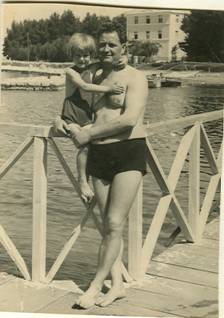
Photo of Ante Sharac holding Vanja, circa 1948.

Boris's grandfather was named Ante Sharac. My mother's father, Ante's brother was named Jack (Ivan) and a third brother was named Josef. Josef was brilliant and sent to Prague to study chemistry. "This was like someone in Africa being sent to Harvard 100 years ago", Boris explained. Ante produced Vanya, Boris's mother, who became a dentist and visited my mother and father when they were in Germany around the time I was born; subsequently, my parents visited Vanya and her parents in Sibinek, where I now type this missive.

Ante's brother, Jack, my Grandfather, produced Doris, my Mother. The chemist, Josef, produced Ruza, also a PhD Chemist, who I later will meet. These three brothers owned a house in Sibenik, and it was the recent selling of this property that brought a cast of characters together after nearly 50 years, as the inheritors -- children of Ante, Jack and Josef – deal with the paperwork and funds from the sale.


Photo of Josef Sharac, circa 1930.


Boris takes me to a lake where the citizen's of Zagreb strut there athletic selves (they are a comely people) and to a park where people walk their dogs and children giggle over ice cream. Afterwards, we visit Ruza for more family history and a look at pictures from her archives, before all three go to Boris's house for a home cooked meal. There I meet his wife, Dragana and son, Ivica (daughter, Antica, was on one of the 1,100 Croatian islands studying biology). As his wife sang to herself as she finished dinner, I try a home made wine from the island that Boris has his summer house. It tastes like a blend of wine and champagne, and after six or seven glasses, I’m a happy camper.

I didn't want to say goodbye to my cousin. But what else could we do. Tomorrow, I'm off to Zadar.


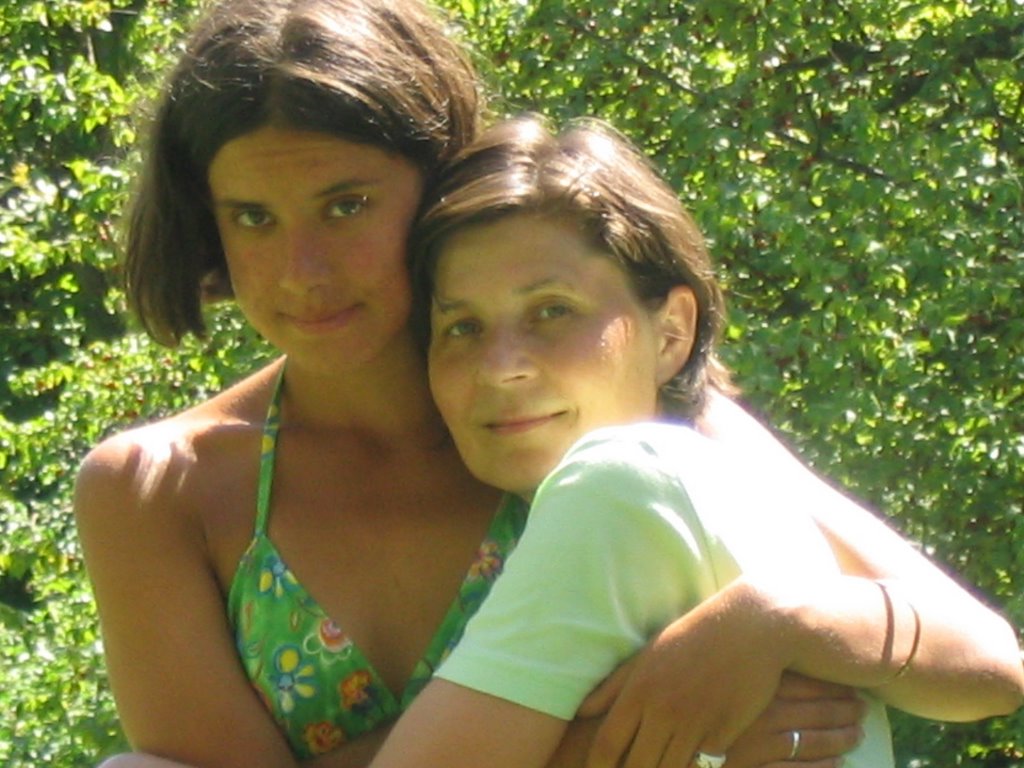
Pictures above are of Boris's son Ivica Culina, daughter Antica and wife Dragana.

To Zadar (10/3)

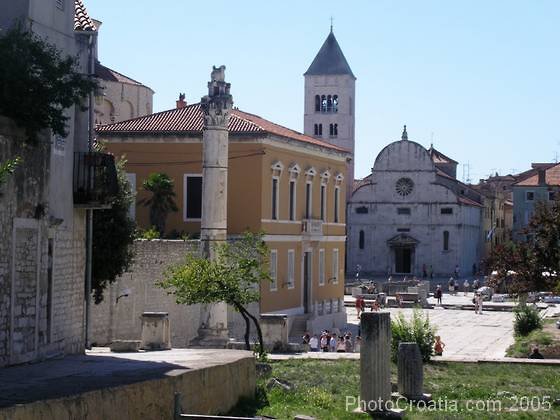
The author of the Lonely Plant book for Croatia says about Zadar: "...has undergone an astonishing transformation from morose and war damaged to ebullient and dynamic." The plan: Bus from Zagreb to Zadar -- which is about the center of Croatia along the coast -- see what the author exclaims, and then head south along the coast to Sibenik, former home of my mother’s father and launching point to a nearby island called Kraponj, where my father’s father hails.

http://www.photocroatia.com/GALLERY/photo.php?photo=11847&u=745|23

After smothering myself in a nostalgia born of stories, not memories, I’ll head south to Split to meet my friends (Mike, his gal friend Colleen, and buds George and wife Pam; and their friends Stan and wife Mary). The plan continues from there, but you’ll hafta wait for future submissions to learn about it.

Did I mention that the Plan was supposed to include a stop at Plitvice Lakes National Park, one of the natural wonderlands of Croatia? That part of the Plan was tossed when the surly bus driver proved to me that I don’t where I am. Duh.

Humper

Two people commander a bus in Croatia: driver and ticket master/luggage-humper. The Humper took one look at me, grumbled something when I massacred his language, and made an effort to aim at me for the duration of the bus trip. The ticket I presented him was to Plitvice; I had none yet for Zadar.

The bus stops many times along the 100+ km trip. Unbeknownst to me, it stops at Plitvice. When it continues after stopping at Plitvice, I remained sitting on the bus, wincing every time Humper walked by checking passenger tickets, including mine, again, sure that he would find something wrong with the punched remnant of a ticket I had and throw me off the bus.

The bus stops by a restaurant, and everyone gets off. I’m confused. I ask the dapper driver the whereabouts of Plitvice. “Passed it” he said, with an Imperial carriage that seemed so befitting a man of his occupation. It’s raining. I made one of my very rare, decisive, on the spot decisions: “May I buy a ticket on to Zadar?” He scowled, though it’s less menacing than Humper’s who is called over and, shaking his head in wonder, presents me a ticket to Zadar.

Accommodating Zadar

Traveling like I do is work, perhaps the most I’ve had of late. You gotta figure out how to get from A to B, get the ticket, find the bus, deflect scowls, know when to get off the bus, find the luggage storage so you can be less encumbered as you trot around looking for accommodations that you can afford, arrange for the place and price, find the place, and pass out for an hour before exploring B.

The sweet lady that rules the luggage storage at Zadar tries her best to give me directions to the least expensive place that Lonely Planet says is close to the “old’ town, but, as I’m finding in every city, Zadar’s roads and walkways are a labyrinth (or perhaps my sense of direction is). I walk ­-- no trudge -- ­ for over an hour, getting more and more frustrated as I twice circle back to where I began. Finally, find the dump, pay my $20 for the night and proceed to get lost on my way to the bus stop to retrieve my luggage. Then, now with luggage hoisted on my back, as opposed to the sane alternative of rolling it, I, again, get lost trying to, again, find the dump. I do make it. I’m wet from rain and sweat. But undaunted, after a quick rest, I suit up and discover Zadar.

Except, I get lost finding it. Or at least this “old” part.

Rummaging around Zadar

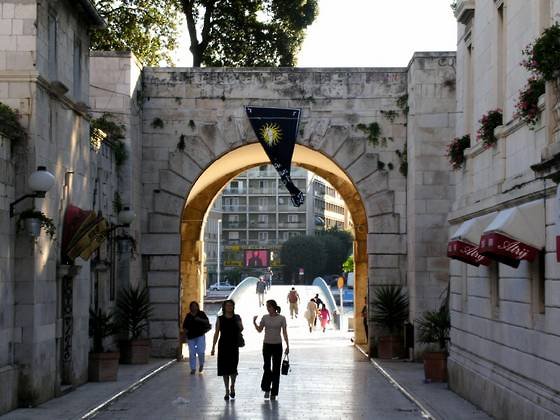
Zadar has a population of about 69,000 people. Like most places around here, it’s old; it began in the 9th century BC. That’s before the God that we in the West know was, at least in the current manifestation of “God, Christ and the Holy Ghost”. Over time, like the rest of Croatia, various people came to drive those already here, out. The fortress wall that surrounds “old” Zadar was fortified by each succeeding conqueror. It is a massive spectacle. There’s beautiful old stuff everywhere next to sparkling bays and inlets which in Croatia are everywhere.

Not as massive, but an equal spectacle, some would argue, are the women under, say, 25 years of age (the others must be working or at home). They are uniformly shaped as God intended (the pre-Western God): ­ tall, long legged, lean -- and come with sprayed on blue jeans. Somehow, Croatia has been able to put a pair of blue jeans in an aerosol spray can. All women of this age category wear them. The men wear a looser model that probably once was on a hanger, as well as stylish running pants and the like. I couldn’t help but notice.

I’m hungry. Besides the meal at my cousins in Zagreb, I’ve existed on the almonds and various powders and potions I brought with me. Somehow, my level of intimidation at trying to order food exceeds my real need for food; after all, I’m still basically conscious and able to walk about. With all the fasting I’ve done over the years, guess I’m used to not eating. But it would be more comfortable if I did, I would think.

Hunger trumps intimidation. Before I leave Zadar, I score a piece of pizza in one of many, many such providers in each Croatian town, typically nestled in groups within the historic buildings that together constitute the “old” sections of every town I’ve visited so far. It was simple, really. I abandoned any attempt at speaking the Croatian language and just approximated the behavior of the Brits I’ve observed: “Hey, mate, how bout a piece of that lovely pie?” It worked.

Sibenik (10/4-6)

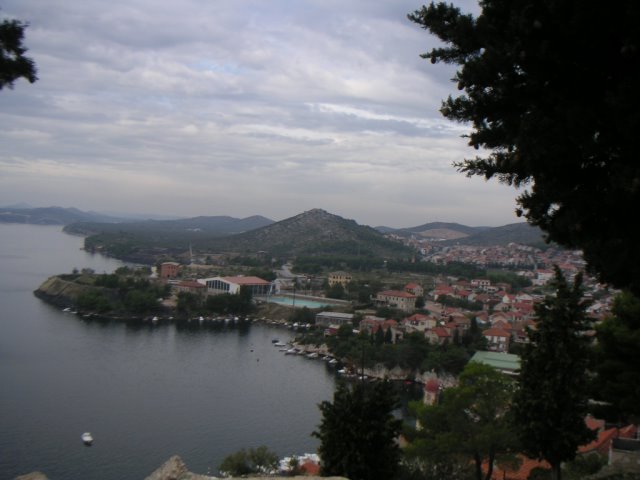
My trusty guidebook said that “Nik Travel” in Sibenik could book me a private accommodation and they did. After disembarking from the bus after an hour and a half ride south along the coast from Zadar, I go to the Information Booth and without hesitation, after some garbled attempt at “Good Day”, went straight into English and inquired the whereabouts of Nik. As providence would have it, I find it, almost straightaway, about one km away.

http://www.photocroatia.com/GALLERY/photo.php?photo=8949&u=1904|37

Again, rather than ask in Croatian if the Nik gal understood English which usually results in a confused look framed by knitted eyebrows, I ask the question in English. “Yes, yes”, was my answer. Sigh. In 20 minutes, the dapper owner of an apartment appeared in the office and drives me to my very own apartment for the next two days. I scored on this one -- two bedrooms, three beds, bathroom, kitchen and balcony just for moi (err, “te” in Croatian) for about $35/night. Helps to be here off-season, but for the rain.

Did I mention the place also has a TV? And my sister would take great delight in knowing that the first channel I surfed to was airing the “Gilmore Girls”.

It was hard to tear myself from that fascinating show, but I was a man on a mission. The Plan for Sibenik is to find the home island of my father’s father (the “Garmas”) and to find the house of my mother’s father (the “Sharacs”); the former being about 5 km away, indicates the map, and the latter being up the hill from my apartment, so says cousin Boris.

I begin with what I deem to be the easier of two, and set off to find my mother’s father’s digs, which he owned with two brothers once upon a time many more moons ago than anyone likely to read this has seen.

I get about 200 meters away before being waved down by a local man about 60 years of age. He’s smiling and talking a mile a minute, and before I can sputter “Ja ne razumijem… Ja govorite engleski” (which takes me 15 minutes of preparation), he has my hand clasping his and they’re both shaking up and down. “Ne, ne, ne”, I protest… “I’m not cousin Igor”. He pauses for a second, and then dives back into the banter and hand shaking. I shake my head some more. He steps back, takes a long look at me, shrugs and we continue our respective missions -- his probably to find Igor and mine to find Grandpa Jack’s crib.

I spend an hour looking, but never find it. I do, however, get very wet. Very wet!

Well, I have another day and a half to find it, I reason, so let it go. Before going through the gate in a tight alley that leads up one story to my apartment, I enter a modest size grocer to buy some grub to cook; I have a kitchen after all. Everyone parks their umbrellas by the door, but I don’t have an umbrella because I’m real decked out in a super tech jacket that does it all: anti-wind/wet/cold and some style to boot. I wander around, and bring my catch to the cashier. She looks at me with some tired took, sighs, takes my apple somewhere to be weighed, brings it back in its own brown bag and tells me what I owe in English. She definitely didn’t take me for Igor.

Serendipity in Kraponj

October 5th is my second day in Sibenik. I head off to find Kraponj, the small island that once long ago produced my paternal Grandfather, Anton Garma. The lady at the bus depot's Info Center confuses me. The local bus to Brodviska, the small town on the mainland that is the departure point for Kraponj, doesn't leave from the bus station, but from somewhere else unfamiliar to me. I sat on a wall (stone of course) and considered a taxi. I knew my destination was close, about 5 km, but the Lonely Planet warned of the expensive taxis. "Well, I'm this close, can't let money stop me", I reasoned as I climb into a Mercedes taxi and tell the completely non-English-speaking Croat what I wanted to do. And we're off. 5 km. $22 dollars.

The taxi driver points to where the boat will take me to the island, which I clearly see is but 300 meters away. I walk down a small hill, look about as nonchalantly as I can and wait. Three guys are trying to place a fork load of cement bags in a boat the size of my bathtub. A couple of women lean against a wall; uncharacteristically, they don’t speak to one another. Mostly it was silent, and I saw no evidence of a passenger boat.

I enter a cafe up the hill and was summarily dismissed by an irritated man saying "Arrete, Arrete." So I entered another cafe across the street and approached a woman behind a bar. Yes, she spoke English and told me when the boat would arrive, but was particularly disinterested in my expressed my familial reasons for visiting Kraponj.

But the Mike Dikta look-alike character I observed sipping his pivo (beer) at a corner table is not. "Say your Grandpa's name again", he bellowed out in a strange Croatian-Aussie accent. I told him. He waves me over. I sit down just as my kava (coffee) is served. Lovre is his name and he proceeds to tell me all about the Garma's he knows. "Come with me" he tells me, and we walk down the hill just as a small canopy covered boat arrives to putter us to Kraponj.

Along the way, Lovre introduces me to everyone in earshot, and retells my story. Some nod appreciatively; others say the Croatian equivalent of "No, don't know Anton, but what about so and so Garma"?

The boat slides into its docking station. No one asks for fare, so I follow Lovre who beelines for an elderly, hunched man. They start talking. The man looks at me. They continue talking. The man again looks at me and slowly, like a sun rise, he smiles and thrusts out his right hand to shake mine. His name is Rocco Garma, and he claims he is my father's cousin.

Lovre fades left, and Roco takes me for a walk around the island known for it's flatness, average elevation (three meters) and fame (sponges and the world record holder for underwater breath holding). The walk lasts one hour, but seems longer as I fence with his Croatian and he shakes his head disapprovingly that I don't know my mother/father tongue.

He shows me Anton's house, which is next to his own. It’s rubble. Nice looking stone though – a naturally formed heap. Roco's doesn’t look much better, so I’m shocked to find a modern looking, clean home inside the, well, visibly organized rubble that constitutes the outside of the house. Inside is a diminutive woman in traditional grab, almost Muslim like, with a scarf covering her head. His wife, he says. We shake hands. No sun rise here, just some head nodding. I decline the offer of drink and Roco and I continued our walkabout until I say goodbye at the wharf. We hesitate for a moment, we two of different generations, from such different worlds, and yet connected by blood. He sighs and turns away.

The return trip to Sibenik is less expensive. Knowledge is a valuable thing. Armed with knowing when and where the bus would come, I used it. But not knowing what the fare was or what the fare man told me it was, I held out a hand filled with coins. He took 15 Kunas ($2.10) and gave me a receipt that I saw once seated read 6 Kunas. Well, another rip off, but I was happy that I wasn't in a taxi, particularly since a busload of teenagers just returning home from school kept me entertained all 5 clicks to Sibenik.

Photo:http://www.photocroatia.com/GALLERY/photo.php?photo=1742&u=1904|87

Two hits in one day?

Back in Sibenik, I try again to find my mother's father's house. It starts raining hard. I persist. The rain, failing to dissuade me patiently waits for the night to join ranks and together they press me to abandon the search. Finally, I do so and begin a new search for an Internet Cafe. This proves to be almost as tough as finding Granpa Sharac’s house, but this time I prevail in finding perhaps the only such place in a town of 30,000 people, carefully tucked away upstairs in a bar which says "Bar" outside, not "Internet Cafe". I find this to be the perfect combination... beer and a computer... and I type away as an efficient bar maid climbs the curving steps to my perch and feeds me beer. She makes several such trips and I am happy.

One More Attempt

October 6 is the last day to find the house that Grandpa Jack owned with two brothers, the recent selling of which brought my far flung relatives here in Croatia in communication with us Americans once again. I only have till 10:00 AM to accomplish this deed. There are literally many twists and turns in this story, but suffice to say I found it.

I ask three people, including the Tourist Agency, where it might be, and they all squint, close an eye, and pointed.... there! One problem is that all the maps of Sibenik that I've consulted look like they were made by someone who went into his backyard, pulled a chicken from the coup, dipped her feet in ink, and had a lusty rooster chase her over parchment that was then marked with street names and shrunk down to a 8 by 11 sheet of paper, the very one I have in my pocket.

I need to find "Ruze Vukum #1". With the map crumpled in my hand, I climb one of the many steep stone stairs that cling to steep hills reminiscent of Sausalito, CA except these stairs are massive stone blocks. The view takes my eyes way out to sea.

I find Ruze Vukum #1 just about 1 km from the alley where I was staying. One thing that my Grandfathers have in common is that both their houses are now basically rubble.

Satisfied with my intrepid deed, I roll down the hill to the bus stop just in time to board the bus to Split for a reunion with friends and the start of the sailing trip to the islands on a gulet named “Hera”.


To Split (10/6)

The bus trip to Split swung along the jagged Dalmatian Coast. Red tiled houses dot the landscape, many with large signs displaying four languages of the word "room". It seems that a large portion of those who live anywhere where tourist go either supplement or rely primarily on room rentals for their livelihood. Some of the homes still have bullet holes splattered across their outside walls, a chilling reminder of the "Homeland War" that ended about 11 years ago.
Photo:http://www.photocroatia.com/GALLERY/photo.php?photo=10915&u=918|6

General Wesley Clark, then Supreme Commander of NATO, who bombed Serbia into submission, is still highly regarded here.

Upon arriving in Split, I park my luggage in a secure zone, and went looking for Daluma Travel where I arranged a "private accommodation" in Split near the Old City which features Diocletian's Palace, one of the most intact and spectacular ancient architecture in the world.

Daluma was within one block of the bus station, and there I met my email correspond and owner of the agency, Stepjan, a white haired man with twinkling eyes and an easy smile. He told me he arranged a room within 200 meters from the hotel in the "Palace" where I would meet up with my friends later in the day.

Hotel Peristil, Split, Croatia: www.hotelperistil.com


In the 15 minutes it took to retrieve my luggage and return to the agency, the owner of the apartment containing my room was already waiting under an umbrella to escort me. She’s in a hurry to show me the accommodations and then board a bus to get to the school where she taught literature. Our walk to the apartment is a comedic scene of me both pulling my wheeled luggage and lugging it over steep stairs, as she maintains a breathless pace.


She is a sweet, elderly woman with sad eyes. Her place is in disrepair, but the bathroom, though small (they all are), is clean and functional. I settle in for a half hour before seeking the exclusive Hotel Peristil where Mike Kilbride and soon-to-be comrades in sailing are staying.

Of course, I get lost, but after wandering for awhile, I’m back on track through the blessed instructions from a Turist Biro (one's in every town). There's a message for me from Mike at his hotel. I will join them in the hotel restaurant at 6:30 PM, which I do, and thereupon meet the my comrades: Mike, gal friend Colleen; George, wife Judy; Stan, and wife Mary.

Krka (10/7)

After getting acquainted with the comrades last night, Mike, Colleen, George, Judy and I go on a private tour to the Krka State Park. Along the way, we stop in Sibenik, where I had already visited, and got an insider's look at the history of the place. Our tour guide is an endless reservoir of knowledge.

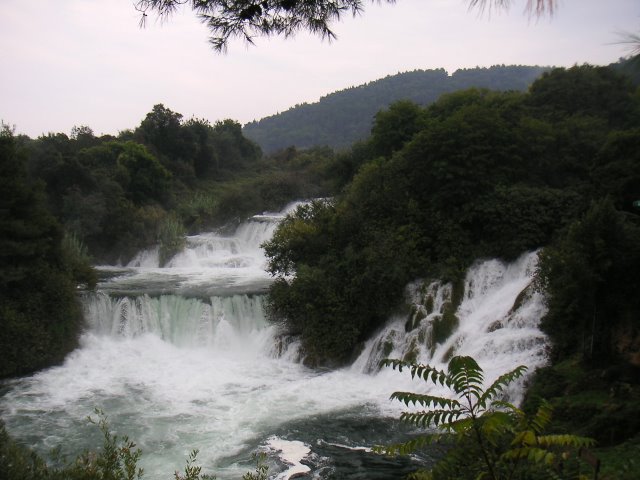
We get to Krka about a half hour before the rain. It's a natural wonder.


A boat ride takes us to a mezzanine of waterfalls and wooden paths suspended over soggy moss, rivulets and rocks. All of us are wet and totally delighted.

Tomorrow, I meet my mother's first cousin, Vanja, mother of Boris, and her husband, Mirko. Then board the gulet and sail away to our first island adventure in the rain, of course.

A Relative Joy (10/8)

Miscommunication and a change of plans about when to launch the sailboat, a 66 foot Turkish made "gulet" named “Hera” put some egg on my face; twice I had to call my Mother's cousin, Vanja, via an English/Croatian speaker to change plans. But finally, the date was set: today at 9:30 AM we meet at the beautiful Hotel Peristil which is not only within Diocletian’s Palace, but shares an original wall with the palace garrison wall built some 1,700 years ago.

Diocletian was quite a character.

This Son of Jupiter thought it politically expedient to kill Christians, but was particularly wary of his potential future. Since he knew that the Roman emperors before him commonly ended their reigns in a particularly unsettling manner -- assassination -- our guy decided that he'd rather retire, the first Roman Emperor to do so. In 295, a good ten years before retirement, he started building his retirement palace in Split, now a Unesco World Heritage site. Finished in 305 and considered one of the most imposing Roman ruins in existence, the harbor-facing palace was built from lustrous white stone from the Croatian island of Brac. The highest walls measure 26 meters, and the entire structure covers 31,000 square meters. There are now quaint and chic shops intermixed throughout and within ancient buildings. Three thousand people live inside the walls, but if you close one eye to this, and open the other to what was... there you are, gladiator, sword in hand as the lion leaps for your throat.
Just before 9:30 AM, I stand amidst all this antiquity, in the drizzle, looking for Vanja. I saw her before she saw me, and despite her being nearly 50 years older than the picture I had of her in my pocket, her beauty was undiminished. I smiled at her and she then knew it was me. She came with a neighbor, Josef, who grew up with her son Boris; together they played soccer across the street from their home in a field that is no longer. Josef is our interpreter. Vanja speaks some English -- after all she had studied English written textbooks all through college and dental school, but since she had few opportunities to speak the language, she is unconfident and hesitant. We walk a short distance outside the palace walls, pile into Josef's black new Jeep, and drive 15 minutes to Vanja's home.


Mirko, Vanja's husband, greeted us at the door. He speaks no English, but his eyes speak his affection for this moment. He’s been ill of late and looks a bit weary and rumpled, but at the same time is delighted by our company. Ushered into the living room, a bottle of Scotch is soon produced and toasts are made. We had an hour and a half to visit, and I want to absorb every minute of it.