Tuesday, December 20, 2005

Havar (10/9)

As I’m aiming a shower of cold water (that pulsed from a hand held shower head extending from the sink in the bathroom annexed to my stateroom) at specific body parts tolerant of such abuse, the gullet slips away from its mooring, turns to face the Adriatic Sea, and Split retreats past my port hole.


The day is cloudy but bright. There’s no hint of rain. Being a gullet, this vessel has two masts and corresponding sails, but they’re largely ceremonial. We motor along at nine knots, which means that in two and one half hours we’ll be near the island of Hvar, known for its fragment and medicinal lavender fields, and the sunniest spot on Croatia: 2,724 hours per year, on average.

The first to have taken a shower on Hera, I join the Company sitting at the table and upon cushions in the stern, and begin to explain how it’s done. Everyone looks at me patiently bemused, as everyone here either has boats or has had extensive experience on them.

Stan and Mary, always gentle, nod in approval. I met them at Hotel Peristil the day after they arrived to join the Company for the gulet journey. Long-time friends of George and Judy, they are excited about not only this journey, but the larger one they are about to undertake,

for the sale of their New Port Beach house is the only remaining thing that stands in the way of retirement. The gulet trip is just a prequel.

Before we tie up to Hvar, however, we find a tranquil and quiet nearby bay to anchor and have lunch, which was to become our practice in the days to come. As the cook prepares what would be a marvelous feast, Mike Kilbride dives overboard. Surfacing, he shows us a beaming face.

“Is it cold?”, someone shouts.

“Perfect”, he says, “But if it wasn’t, I’d lie.”


Judy and George Leeper
That comment is vintage Mike. And, in keeping with his manner, he says nothing more as he treads water, floats back upon the water, climbs up the ladder and repeatedly dives into the translucent blue; his joy distinguished from its opposite only by the slight upturn of his mouth, something I’ve seen him subtlety fight to control, as if the pleasure he feels from a good meal, a glass of Cabernet, or recounting the success of his real estate investing methodology might overwhelm him, make him preen too much, and thus make him slip from his vigilant self-control.


I’ve known Mike since college days at UCSB. After initial career success, he struggled. I hired him to work with me at E.F. Hutton, where he excelled, but the purchase of the company by Shearson put us all on the street, and Mike again struggled for years before beginning a pipe construction company in New Port Beach, CA. Now, ten years later, he’s on easy street. Through the sine waves of life, the ups and downs, Mike has always been the same: even, steady, self-controlled and confident. It just took awhile for the spheres to finally catch up. (I’m still waiting.)

On Hera, my gaze moves from Mike to a small, unpopulated island about 200 meters away that keeps winking at me. Unable to resist any longer, I jump into the Adriatic for the first time in my life, swim to the island, and clamber up sharp coral and rocks that lead to a lush carpet of pine needles covering a narrow trail. Looking back toward the boat, I see Mike bobbing in the water, and the rest of the Company in various states of repose. Hera looked regal floating proudly on a brilliantly azure sea.

Besides being sunny, Hvar is a very popular and chic place. Notables and wannabes from everywhere watch each other from one of many outdoor cafes that surround a large town square. Like most of seaside Croatia, this town has its old stuff – Gothic palaces and traffic-free marble streets lie beautifully ornamented within 13th-century medieval walls.

We wander about and I traverse a path up a hill to see an old walled fort that protected Hvar from pirates, Turks, and various other villains. The view is spectacular. Islands that gracefully sit up tall and thick help ease the sea’s penchant to mesmerize. Red tiled roofs carpet the tops of thick white limestone walls. A soft silence is spread everywhere, and is revered even by the sea birds.

This night I eat with the crew. The Company is elsewhere. Francesco, the Italian co-owner of Hera, co-captain and chef, cooks a sumptuous meal of fish, meats, pasta and salad so fresh that it springs off the olive oil that he made from his own olive trees. The boat stretches to and fro, just exercising the ropes slightly, and the wine, made from Francesco’s grapes, pours from a canteen that has no bottom.

I learn that Francesco has fathered three sets of children by three different wives. At 57 years of age, his oldest is 28, youngest is 6. His current wife is Croatian – a language he has yet to learn after being in the country ten years – and has born him two children. She is 30 and when we meet her, we all recognize that this man must be a magician to have attracted one so much younger and comely then is he. (And taller too.)

The other owner and captain is a good counterpoint to Francesco. Dimar is Croatian, and though I don’t think it’s a testimonial to the relative countenances of Croatians versus Italians, just as much as Francesco is carefree and unperturbed by anything, Dimar wears a permanent frown and is a self-described worry wart. About 30 years ago, at the age of 26, he left his home island of Korcula and went to Australia to make a better life. Now, he has a wonderful stone home overlooking an inlet bay in Korcula’s second largest city, Vera Luka and another home in Brisbane, and of course the gulet, upon which he plans to work half a year, the rest devoted to construction work back in Brisbane.
The third member of the crew is the irrepressible Ivan. This young man of 28 has stories with no end and strong opinions about everything, particularly Croatian political and historical issues. I learn a lot about what they call the “Homeland War” in the early 90s with the Serbs (principally), and what Ivan termed as Croatia’s feeble attempt to migrate from a state-owned to free enterprise economy. He is an apt representative of many young men of the islands: hard working, many having several jobs that shift with the seasons, they are well educated (even if just through high school), attentive, and yearn for a better future.

As the night wears on, the crew and I get silent till the only thing that flickers is one of four channels tuned and delivered by the small TV in the wheelhouse.

To Vis (10/10)

I awake with the Sun, a common occurrence at Hera, and join others in the Company for coffee and a sumptuous spread of bread, our one-ingredient breakfast. The boat would leave around 9:00 AM, so I wanted to take one more stroll through Hvar before leaving.

Seated on the long stone wall that separates the promenade from the sea, I look around.

http://www.photocroatia.com/GALLERY/photo.php?photo=11163&u=881|19

A tall, handsome, well dressed couple descends the last few broad white stone steps of a hundred step journey down into the town, and turns left to walk toward me and the town square behind me. Each held one of the hands of a small child. Right in front of me, they stop. He kisses each child and his wife and turns right to where a couple dozen boats are docked 50 meters ahead. She takes the hand of each child and walks straight ahead into the square. I sit thinking, how wonderful to walk to work, to walk your kids to school, as the ancient, medieval fort on the hill stands guard.

We motor to Vis by the early afternoon, and as was becoming our custom, anchored in a soft bay for lunch and a swim. Vis lies before us and rambles around to our left where its peninsula pushes out into the Adriatic. On it, upon a knoll, sat what looked to be a large estate in disrepair. I jump into the water -- after, of course, Mike had leapt in and gave us all his agreeable grin -- and swam to it.

Three stories tall, with views from nearly every room, the derelict building bursts with potential. I walk throughout the building, my mind buzzing with all the visualized potential, and swim back to report my findings to the Company. The place was thereafter dubbed “Joe’s B&B”, and from there out, on each island where we would see such a place, just yearning to return to its former splendor and abide laughing, eating, drinking, sleeping people from all over the world, someone in the Company would call out: “Hey, there’s another Joe’s B&B”. Soon, in our collective imaginations, each island had such a savory place – this chain of Dalmatian islands each with its own “Joe’s B&B”.

“Ask a Croatian to name their top three islands and one of them is likely to be Vis”, says the Lonely Planet travel guide. I don’t believe the Company is in accord with this estimation, but we find that Vis is quaint, charming, and has a great cemetery.

Vela Luka (10/11)

Pride shows on the faces of the crew as we glide into Vela Luka, the second largest city on the island of Korcula, and their hometown. Without pretense, but with just a hint of pride, Dimar points to his beautiful stone house nestled in the hill overlooking us as we pass by in the inlet leading to the port. This town seems more oriented to its people than to tourists, though like many places in the islands, its population has diminished as

Photo: http://www.chorvatsko.cz/jidalos/pict/velalu.JPG

state-subsidized industries have stumbled beneath the march to capitalism, pushing workers to seek more prosperous places. Ivan and his older brother were unceremoniously shown the door when the boat factory he worked for was downsized after being bought by a businessman. His father’s 30 year tenure earned him no different dispensation then his sons.

Tonight is the “Captain’s Dinner”, meaning that Dimar and Francesco will treat the Company to dinner. We arrive at the appointed restaurant and sit in a courtyard beside a large open pit within which various meats and fish sizzle over a lunging fire. Once seated at the table, we are disappointed to learn that neither captain would be joining us, as we anticipated, though this disappointment soon recedes as red wine flows abundantly and platters of freshly caught and grilled fish are set up and down the long table.

Suddenly, somehow, something unusual happens. The small talk that is common in such settings, between people of good cheer and on vacation, took an abrupt turn. I didn’t see it coming and now don’t know how it was instigated, but there is Judy, next to husband George, both to my right, explaining in earnest that we’re all sinners, and, in principal, a small sin like a white lie was no less sinful than the atrocities of Saddham. A trickle of nervousness electrifies the Company, save Mike, as we each sit straighter in our chairs. George, of a decidedly different philosophical persuasion, goads his wife a bit. She takes the bait.

I didn’t know about Judy’s religiosity, though I observed her kindness and gentleness; attributes that on occasion are demonstrated by those who practice what they preach. Looking younger and fitter than her years – whatever they are – would predict, Judy, or “St. Judy” (or “Mrs. Leeper”) as husband George would often call her, is the mother type. If her arms were large enough, and if she felt comfortable enough that we wouldn’t mind, I’m sure she would hug us all together as she gave us her blessings each night before bed.

Colleen, Mike’s partner, asks some questions both to clarify Judy’s position and to lead the conversation to why she, Colleen, left the Catholic Church. The conversation at this point was about atheism. Judy declared that she recognizes that Mike is an atheist. In quick response, Mike, who until this moment during this trip mostly cast broad smiles and short sentences, looks square at Judy, and in his deep, resonating voice that I observed spellbinding many an audience, said clearly, in measured tones: “I am not an atheist, as I don’t deny that God exists. But we don’t need God to tell us what to do. We know what’s right and what to do.”

Judy: “We’re all sinners… I know God exist because I have a personal relationship with him”.

Stan: “We have no consciousness at all, so we have no values.”

George: “What? That’s ridiculous, of course we have consciousness!”

Mary nodding here and there was mostly silent. I was listening attentively, wondering if I wanted to weigh in. Then, maybe because I was unusually mute, as if on cue, the Company turned and looked at me sitting bemused at the head of the table, and waited for my two cents. I took a deep breath and…

Joe: “Consciousness to me is being self-aware… there’s no value judgment required to have consciousness. With respect to our beliefs – what we think is true to us – but each of us needs to examine the nature of our personal reality, how it’s formed, what part is from our parents, friends, teachers, culture, nationality… all biases that shape how we interpret our experience.”

George chortles some non-word. The rest of the Company remained silent, lost in their respective musings.

We eat more fish and drank more wine.

Mljet (10/12)

Ancient Greeks called the island “Meltia” or “honey” for the many bees buzzing in the lush forests (“lush” by Mediterranean standards). And forests are a plenty – over 72% of the island is covered by forests, the rest dotted by fields, vineyards, and small villages, the inhabitants of which produce wine, olive oil, medicinal herbs and fish. In 1960, the majority of the island was made a national park, bringing a steady stream of tourists to the island and raising the hackles of many of the peace-seeking islanders.

Photo: http://www.photocroatia.com/GALLERY/photo.php?photo=11549&u=879|0

Cash is not King here.

Just outside Mljet, we drop anchor, and I drop into the clear blue. It’s been raining a bit and the sky is congested with clouds, but swim I must. Once on the island, we hatch plans for renting scooters or bikes to explore the natural wonders the following day, before turning attention to the most serious of our decision-making – where to have dinner.

Without orchestration, having all departed the gulet individually or coupled, we nonetheless all find ourselves at a highly rated seafood restaurant two strides from the sea. Before the menus are absorbed, seeking to save ourselves from an overdose of wine, George and I separate from the pack and find a pizza parlor close to where the boat is docked. This is the first time on the journey that we two are alone.

I know a bit about this man from Mike’s tales. This stout, certain man likes to be a tad mysterious, telling me earlier with a grin that even his kids (now grown) didn’t know what he did for a living. It was real estate. Mortgage brokering, property appraisal, investing. His was a tough start: a father at 17, no money, divorce, estrangement; but a few good turns, hard and steady work, and a couple of decades later, at 48 or so, he retired. And now, at 60+ the man treated us all to this gulet, patiently counting the many one hundred dollar bills before departing Split -- pulled from a wad that would choke a dinosaur – carefully placing each on the other onto Hera’s wheel house dining table before the excited eyes of Francesco, and Dimar.

We ordered an extra pizza for the crew and return to the boat to eat there, only to discover that the crew was already eating pizza.

To Korcula (10/13)

The next morning, we arise to the birth of a rainy day, but determined to visit one of the “must sees” of Mjlet. Undaunted by the rain, the Company opts to hike about three clicks to catch a boat to the Benedictine monastery, built in the 12th century on its own little island in what appears to be an inland lake, but is actually connected by a narrow channel to the sea. It’s a wet adventure. By time we return to Hera, the rain has abated, and the crew is anxious to motor on.

Photo: http://www.photocroatia.com/GALLERY/photo.php?photo=12180&u=43|0

For much of the trip we parallel a long peninsula paralleling the mainland and pass several seemingly uninhabited islands, though several of them prominently display rows of mature olive trees marching straight up steep hills and rooted in stone. Many are several hundred years old, Dimar tells us, and then he relaxes into one of his few smiles as he prepares to tell a joke.

“They say that a vineyard is like a wife and an olive grove like a mother. The wife takes and takes and maybe will give something back, but a mother requires nothing and gives always.”

The mothers look at each other with knowing smiles. The husbands look at each other with knowing smiles. Mike and I look at each other grinning, perhaps grateful to have only known olive groves.

Around a bend and there is Korcula protruding from the northeastern tip of the island. Korcula is the name of both the capital city and the island itself. It’s often referred to as “little Dubrovnik”, which becomes obvious as soon as you approach it from the sea, for like Dubrovnik, Korcula is built around an old fortress that one upon a time (it was built in the 15th century) protected everyone hereabout.

We tie up right next to an entrance into the old city, disembark and start exploring. Each person has his own agenda for dinner. Mine, again, is with the crew. Ivan tells me that he will take me to meet his cousin who owns a nearby tavern. After dinner we go to find the cousin, and along the way, I see a boy yank a fishing line and flying from the water is a fat squid about 18 inches long that hits the stone promenade with a thud, and immediately spews black inky liquid.

We can’t find the cousin, but we can find beer. I buy both of us a large one and listen to island stories.

Back to Split (10/14)

One final gaze at the looming fortress beside us, and we shove off early in the morning, for we have a long trip ahead – Split is nine hours away. It is a slow and pleasant experience. Members of the Company quickly ease into their respective modes of napping, reading, gazing, eating and drinking. There was a sense that the sailing voyage was ending, and it seems that each of us wanted the space and time to take it all in, and measure what it meant.

http://www.photocroatia.com/GALLERY/photo.php?photo=10011&u=287|39

Island after island eases by; each prominently displays olive groves, or vineyards, or clusters of red-tiled, stone homes for our eager eyes. The sun was modest, the wind mostly gentle.

Sooner than expected, Split comes into view. As we turn into the harbor, an 80-ton ferry launches from its mooring dangerously close to us. All eyes became riveted upon Francesco at the helm, silently imploring him to take evasive measures now! For a heart beat or two, Francesco acts as if he might not change our direction, as if our right of way would protect us from Davey’s Locker. I watch him, we all watched him, and hold our breath. With a shrug and sigh, he spins the wheel nonchalantly. The ferry horn is blaring. We wave nervously. Close call.

Tonight would be our last on Hera.


The Cetina River and on to Dubrovnik (10/15)

Waking up this morning is a different experience of late. Rather than the quiet of the islands, here in Split I awake to cars rushing by the port, ferries honking and generating swells that push the boat against the buoys that protect it from the heavy white stones that make the promenade. One similarity to past awakenings – church bells: the first I hear are at 6:00 AM. I resist.

Slowly, we intrepid travelers gather our things, pack and then huddle for a group picture toward Hera’s bow. We hardly have finished our goodbye hugs when a motley van appears filled with three strapping guys and a load of gear. They spill out, shake hands with Mike, Colleen and me, grab our luggage, stuff us in the van, and we’re off to our next adventure – rafting the rapids of the Cetina River.

The journey takes about two hours due south and then east over a small mountain and then down into a valley gorge. Along the way, the guides in the van display an obvious affection for each other. There is plenty of Croatian-heckling, back slapping, mock wrestling and a nose tweak or two. My eyes are constantly shifting from the tortuous road winding in and out, up and down, with the ever present sea to our right, to the tumbling in the seat in front of me.

f meWe're let out near the river. Several other vans disgorge their riders, and soon there are about 35 of us donning gear, giggling (well, the others giggled -- we three don't know how to giggle in Croatian), and then we all haul four large rafts down to the river.

We three are put in a raft with two Germans. Our raft is captained by one of the guides in the van who spoke English fairly well; we after all, need to be able to understand his instructions as he barked orders aimed at saving us from injury. This man is big – he could wrestle bears. Studying engineering in college. Early twenties. He has done this trip a 100 times and yet the joy he still feels is obvious to see and hear, for despite his formidable size, this young man would squeal like a child with every dousing the river gave us. I really got a kick from this incongruity.

I was also interested in observing Frog Legs. He too was in our van. We picked him up along the way, and it was once he was in the van that the puerile activities ensued in earnest. He’s smaller by far than the other hulking guides but seemed to be their leader. As we prepared for the rafting, he strips off his pants and proudly, it seems, presents to the world a tiny bathing suit and bulging thighs, the kind a body builder would possess.

Given that his upper body is of normal dimensions, these legs stand out. I watch them bounce him around from raft to raft, person to person as he directs the pre-launch activities. In my life, I’ve know two others with disproportionate legs such as these, and I suddenly realized that they also bounced around. It’s as if the muscles in such legs need to be used, and like anxious thoroughbreds biting at the bit, one does not walk but bounce. (Perhaps with four legs you “prance”).

The river is mostly gentle, but here and there it would gather itself and speed us away and drop us from watery ledges and twist us about. A competition brewed as each raft tried to power ahead to be the first to navigate the forthcoming set of rapids. When we would reach a stretch of calm, those in the other rafts would spontaneously burst out in song. I thought that the only song a group of Americans might all know is jingle bells.

All too soon, it is over. There are a couple of close calls where someone in our raft was thrown into the river -- and in fact, one of the other rafts flipped over -- but no one was hurt and everyone had a grand time. After drying off and changing into warm clothes, we three jump in that same van which, with driver of course, Mike hired to take us the five hour journey to the fabled city of Dubrovnik.

Dubrovnik Ahoy

The drive from the Cetina River to Dubrovnik is long, slow and punctuated with breathtaking sights as the Adriatic to our right dazzles us, and the dry mountains to our left sit as ponderous sentinels. Bananas sustain us. Our only stop was at a border control check where this coast-hugging, single lane road briefly enters Bosnia and Herzegovina (two words, one country) before resuming in Croatia. This segment is a study in contrasts: that BH is
Photo: http://www.photocroatia.com/GALLERY/photo.php?photo=11684&u=322|7

economically poorer than its neighbor is obvious, from the disrepair of buildings to aging billboards. And the police are salient, whereas in Croatia they are hardly noticed. More obvious than the police, however, was a U.S. war ship patrolling an inlet near the border, a heavy reminder of the war a decade ago, and of bellicose attitudes simmering still.

After another hour or two, our proximity to Dubrovnik becomes apparent, for the closer we get, the more populated are the towns just north of the fabled city, and more cruise ships are found in the waterways. In my pocket is the address of my new lodging, and I pull it out to present to our driver. He stops to ask directions and soon thereafter, we pull along side a bus stop near the east gate of the historic and fortified “Old City”.

I can tell from the directions that we’re very close to my destination and I want to get on with it, but the driver motions me to wait as he speaks to a young couple who disappear down the alley that I think leads me to my accommodations. Gestures suggest that I wait. We all wait, and wait until, finally, the couple reemerges, whereupon I say my goodbyes to Mike and Colleen (who now will be taken to their fabulous hotel just east of Old City), and then turn to follow my guides.

Eddy and My Accommodations

At a door in a gate in front of the building where I presume I’ll be staying, I wait again, as the woman half of my guides rings the bell on the gate door. She does it again, and after a minute or two, presses the button again. No response. She looks at us and shrugs. Just before confusion is to permanently congeal, the door magically opens and she disappears. I wait again beside her mute husband (I did determine this relationship at least). Finally, the woman and someone vaguely familiar looking emerges from the house and motions us to a simple courtyard to the left. We all take seats as if there’s something to be negotiated. And, indeed, there is.

The familiar looking man is the owner of the home in which I had already paid Stepjan, the travel agent in Split, for a room and private bathroom. He’s all smiles as he looks at me and says in excellent English, “My name is Eddy and I’m committed to your happiness…. I want you to be completely happy.”

I’ve traveled the world, I’ve known bullshitters, I’m no longer green, and I knew something was up. “That’s good”, I answered as I sat as tall as I could and leveled at him a no nonsense glare, “because I like to be happy.”

Eddy fidgets some and glances down at his clasped hands. “I made a mistake. The people in your room wanted to stay another day and I let them, but this couple here has a nice room for you. Come on, I’ll go with you and show you. It’s in the Old City, so you’re closer to everything.”

I make him repeat it all and guarantee me that the room was of equal quality (which, having never seen the room he offered, I didn’t know what that would be). After all the assurances were expressed, we are about to arise and move on, when two Irish women in their early twenties stride by. Eddy’s attention immediately drops us and rivets into the young women. He didn’t salivate, quite, but then perhaps he didn’t have time to, for after he extracted some guarantees that he’d see them later, they continued on their way. “They’re the ones that were supposed to leave today”, he sheepishly said to me. “I see”, I said, and I did. This Eddy is a player at best; more likely a shyster, I thought.

The travel books tell you that it’s a good idea to check your luggage at the bus stop before you go looking for accommodations so that you’re more mobile and don’t let the hassle of lugging luggage influence the choice of lodging. I reflect on this as I roll my bag down the cobble stone side walks and down the white stone steps of the Old City, trying to keep up with my three guides. They are unsympathetic to my desire to pause here and there to absorb some history, like the Pile Gate, for instance.

The Pile Gate is the eastern entrance to the Old City, built in 1537 and containing the statue of St. Blaise, the city’s patron saint, set in a niche at the apex of the Renaissance arch demarking egress and ingress into this place.

Along the way, Eddy greeted and was greeted by someone every few paces. “I see that you’re the Mayor”, I said. “No, just lived here all my life”, he said. That would be about 40-some years, I thought.

http://www.photocroatia.com/GALLERY/photo.php?photo=9514&u=322|108

We are about a block into the Old City walking on the main thoroughfare, simply called “Placa” when I glance at Eddy to see who he is talking to. A tall blonde woman with a harried look has replaced the couple that was beside Eddy just a moment ago. Noting my confusion, Eddie enthused, “This is great. This is Ana and she has even a better place for you to stay… we’re going there now. I am committed to making you happy.”

Feeling defeated, I meekly follow.

Toward the end of the Placa, right across from St. Blaise’s Church, we turn into an alley, walk through a narrow door, and I bump my luggage up three flights of narrow stairs to a small three-story apartment. “This is Ana’s place”, Eddy says as he takes a seat at a round dinning table beside the room earmarked for me. Upstairs is the bathroom. Helene lives upstairs in a separate part of the apartment with her husband and kids. Her husband was wounded in the war.

“Hey, Ana, Joe can bring women here, right… make an exception is his case… he’s Croatian!”, Eddy says in what was becoming his characteristic heckle. In what was to be Ana’s only words to me, but not really to me, she replied, “I don’t care what he does”. That attitude precisely fit the quality of this dump, where I was to spend the next four nights. Gratefully, outside the building containing the dump was a wonderland.

Stari Grad Walkabout

I’m given the key, and, unceremoniously, both Eddy and Ana turn, walked down the 10 stairs to the door to the apartment (with just a hundred or so to go) and disappear. I breath a sigh of relief and look around. Frankly, it was only then that I had enough focus to truly assess my new digs and designated it “Hotel Dump”. I yearned for that simple but relatively luxurious apartment in Sibinek, but told myself that one needs to give and take when traveling, so I’ll give myself a break and endeavor to enjoy the “experience”.

Quickly parking my stuff, I grab my Lonely Planet guidebook (page turned to the Dubrovnik chapter), gallop down the flights of stairs, and enter the brisk-turning air of the Old City as twilight approaches.

In ten strides, I leave the alley and step into the famed pedestrian thoroughfare, the Placa. No cars other than service vehicles are allowed in the Old City, or “Stari Grad”, so it’s a great place to people watch, and given the worldwide popularity of Dubrovnik, you can see people from everywhere here. Unlike elsewhere in Croatia, here Americans amply contribute to the tourist composition. And what we tourists all observe is majestic, magical and historical.

Right across from my alley is the imposing baroque church, St. Blaise built in 1715, a relative youngster in this place. I stand for awhile and gaze at it, and as the outside light dims with the approaching night, the inside light of the church is revealed in strong colors of blue, red, purple and yellow through its hauntingly beautiful ornate stain glass windows. I turn to the left and gaze at the large and tall stone Clock Tower that demarks the east end of Placa, just before this broad walkway narrows and leads in a slightly upward and curvy path to the western entrance/exit called “Polce Gate”.

Taking this in, my appetite is whet and I decide to quickly dash up Placa to take note of the sights to be recorded on my camcorder tomorrow, before dusk pulls down its inevitable nightshade.

My Lonely Planet guide book makes this surveillance of antiquity easy, at it suggests a self-guided tour that begins from the western gate – Pile Gate – through which I first entered Stari Grad. I again study the Renaissance Gate itself and the drawbridge at its entrance that once upon a time was raised every evening as the gate was closed and the key given to the Prince.

Next, after entering the Old City, I note step-worn stone stairs to my left that lead steeply up to the rampart of the aged stone wall that encircles the town. Right before me, just to the right is Onofrio Fountain, a famous landmark built in 1438 as part of a water-supply system. Sixteen carved stone masks gush water from their mouths into a drainage pool.

Beside the stairway to the town wall, I encounter St Saviour Church build between 1520 and 1528, and a few meters along Placa to the east is the Franciscan monastery and museum built in 1498. Moving east, a quick detour off Placa is the site of a Serbian Orthodox Church dating from 1877, and containing a fascinating collection of icons dating from the 15th to the 19th century.

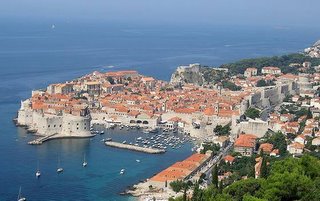
Nearby is the city’s 15th-century synagogue, the oldest Sephardic and the second-oldest synagogue in Europe. I could recount several more, all inspiring given that their pedigree and location huddled 824 buildings surrounded by massive white stone walls reaching heights of 75 feet and nearly 2 km around at the edge of the sea.

I leave the Stali Grad and climb a nearby hill that overlooks it. The moon by now is high and it baths this antediluvian place in a soft luminescence. A spell is cast. I remain motionless for time uncounted.